
Crown Solar Panels Price in Pakistan: Complete 2026 Buyer’s Guide
Updated : July 2026
Pakistan’s energy crisis has pushed thousands of homeowners and businesses toward solar power, and Crown solar panels have emerged as one of the most sought-after options in the market.
If you’re researching Crown solar panels price in Pakistan, this comprehensive guide covers everything you need to know about costs, specifications, comparisons, and whether these panels are the right investment for your needs.

Current Crown Solar Panels Price in Pakistan (2026)
As of January 2026, Crown solar panels are priced between Rs. 29 to Rs. 30 per watt in Pakistan. However, the total cost varies significantly based on panel wattage, system size, and additional components.
Crown Solar Panel Price by Wattage
| Panel Wattage | Price Range | Best For |
|---|---|---|
| 540W Crown Panel | Rs. 15,660 – Rs. 16,200 | Small to medium homes |
| 550W Crown Panel | Rs. 15,950 – Rs. 16,500 | Medium residential setups |
| 580W Crown Panel | Rs. 16,820 – Rs. 17,400 | Larger homes, small commercial |
| 600W Crown Panel | Rs. 17,400 – Rs. 18,000 | Commercial and industrial use |

Complete Solar System Costs with Crown Panels
Understanding per-watt pricing is important, but most buyers want to know the total system cost:
3kW Solar System: Rs. 522,000 – Rs. 540,000
- Suitable for small homes with 2-3 bedrooms
- Generates approximately 12-15 units per day
- Includes panels, inverter, mounting structure, and basic installation
5kW Solar System: Rs. 870,000 – Rs. 900,000
- Ideal for medium-sized homes or small offices
- Generates approximately 20-25 units per day
- Can power most household appliances including ACs
10kW Solar System: Rs. 1,740,000 – Rs. 1,800,000
- Designed for large homes or commercial establishments
- Generates approximately 40-50 units per day
- Suitable for running multiple air conditioners and heavy appliances
15kW Solar System: Rs. 2,610,000 – Rs. 2,700,000
- Perfect for industrial applications or large commercial spaces
- Generates approximately 60-75 units per day
- Provides substantial energy independence

What Makes Crown Solar Panels Different?
Crown solar panels have gained significant market share in Pakistan for several compelling reasons that go beyond just competitive pricing.
Technical Specifications
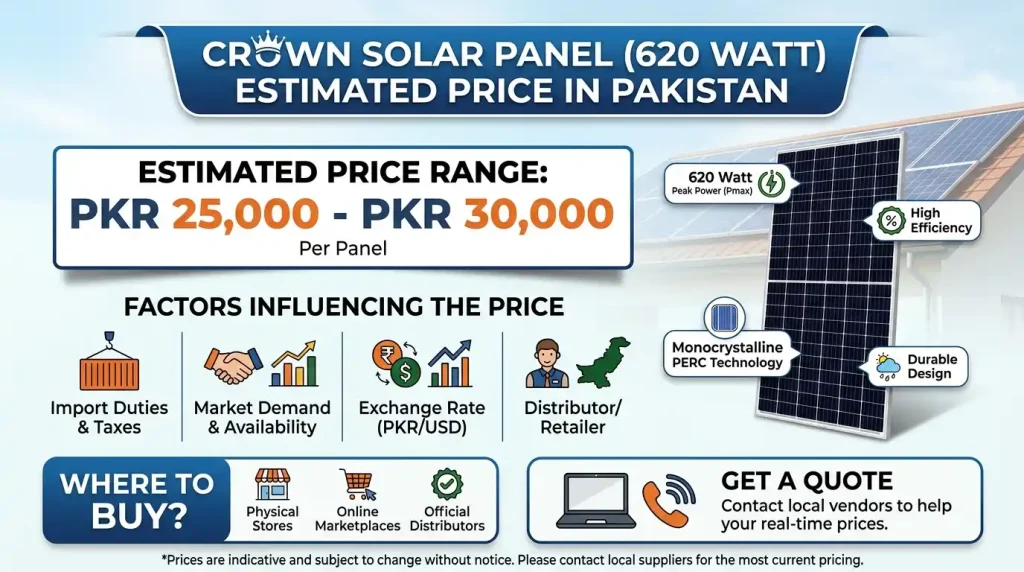
Crown panels utilize monocrystalline PERC (Passivated Emitter and Rear Cell) technology, which offers superior efficiency compared to traditional polycrystalline panels. The typical efficiency rating ranges from 20.5% to 21.5%, meaning more electricity generation from the same roof space.
The panels feature a robust aluminum frame with anodized coating that resists corrosion in Pakistan’s varied climate conditions. The tempered glass covering is 3.2mm thick with anti-reflective coating, maximizing light absorption while protecting the solar cells from hail, dust storms, and physical impact.
Performance in Pakistani Climate
Pakistan experiences extreme temperature variations, from scorching summers exceeding 45°C to cold winters in northern regions. Crown solar panels are designed with a temperature coefficient of -0.35% per degree Celsius, which means they maintain better performance in high heat compared to many competitors.
The panels also perform well in low-light conditions, which is particularly beneficial during winter months or cloudy days. Independent testing shows Crown panels maintain approximately 85-90% efficiency even under diffused sunlight conditions.
Build Quality and Durability
Crown panels undergo rigorous quality testing including:
- Salt mist corrosion testing for coastal areas
- Ammonia resistance testing (important for agricultural regions)
- Dynamic mechanical load testing (simulating wind and snow pressure)
- UV degradation testing for long-term performance
The junction box is IP68 rated, providing complete protection against dust and water ingress. This is crucial in Pakistan where monsoon rains and dusty conditions can affect solar panel performance.

Crown Solar Panels vs. Competitors: Honest Comparison
To help you make an informed decision, here’s how Crown panels compare with other popular brands available in Pakistan.
Crown vs. Longi Solar Panels
Longi is considered a premium brand with prices ranging from Rs. 32-35 per watt. While Longi panels offer slightly higher efficiency (21-22%), the performance difference in real-world conditions is minimal. Crown panels provide 95-97% of Longi’s output at approximately 15% lower cost, making them more cost-effective for most buyers.
Crown vs. JA Solar Panels
JA Solar panels are priced similarly to Crown at Rs. 28-31 per watt. Both brands offer comparable efficiency and build quality. The choice often comes down to dealer availability and warranty terms in your specific region. Crown has a slightly more extensive dealer network in smaller cities.
Crown vs. Canadian Solar Panels
Canadian Solar is another premium option priced at Rs. 33-36 per watt. While Canadian Solar has strong brand recognition and excellent warranty support, Crown panels offer better value for budget-conscious buyers without significant performance compromise.
Crown vs. Jinko Solar Panels
Jinko panels cost Rs. 30-33 per watt and are known for reliability. Crown and Jinko perform similarly in efficiency tests, but Crown typically has better local availability and faster warranty claim processing in Pakistan.

Factors That Affect Your Final Crown Solar System Cost
The per-watt panel price is just one component of your total investment. Several other factors significantly impact the final cost.
Inverter Quality and Type
The inverter converts DC electricity from panels to AC electricity for your home. Quality inverters from brands like Growatt, Solis, or Huawei cost Rs. 80,000-250,000 for residential systems. Hybrid inverters that work with batteries cost more but provide backup power during outages.
Battery Storage (If Required)
If you want backup power during grid failures or for nighttime use, you’ll need battery storage. Lithium-ion batteries cost Rs. 120,000-180,000 per kWh of storage capacity. A typical home requiring 10kWh storage would spend Rs. 1,200,000-1,800,000 on batteries alone.
Mounting Structure and Installation
Professional installation with proper mounting structures costs Rs. 15,000-25,000 per kW. This includes:
- Galvanized iron or aluminum mounting rails
- Roof penetrations with waterproofing
- Cable management and earthing
- DC and AC protection equipment
- System commissioning and testing
Net Metering Registration
If you plan to export excess electricity to the grid through net metering, registration costs vary by DISCO (Distribution Company) but typically range from Rs. 20,000-40,000. This one-time cost includes application fees, inspection charges, and meter installation.
Maintenance and Warranty Costs
While Crown panels come with warranties, consider setting aside Rs. 10,000-15,000 annually for cleaning, inspection, and minor repairs. This proactive maintenance ensures optimal performance throughout the system’s lifespan.

Understanding Crown Solar Panel Warranties
Crown solar panels typically come with two separate warranties that protect your investment.
Product Warranty (10-12 Years)
This covers manufacturing defects, physical damage during normal use, and premature failure of components. If your panel develops issues like hot spots, cell cracks, or junction box failures within this period, the manufacturer replaces it at no cost.
Performance Warranty (25 Years)
Crown guarantees that panels will maintain at least 90% of rated capacity after 10 years and 80% after 25 years. This linear performance guarantee is standard in the industry and ensures your investment continues generating adequate electricity for decades.
What the Warranty Doesn’t Cover
Understanding exclusions is important:
- Physical damage from accidents, vandalism, or natural disasters
- Performance loss due to poor installation or maintenance
- Damage from unauthorized modifications or repairs
- Normal wear and degradation beyond specified rates
Always purchase from authorized dealers who provide proper warranty documentation and support for claims.
Step-by-Step Guide: Calculating Your Required System Size
Before focusing on Crown solar panel prices, determine how much capacity you actually need.
Step 1: Analyze Your Electricity Bills
Collect your electricity bills for the past 12 months. Calculate your average monthly consumption in units (kWh). For example, if you use 600 units monthly, that’s your baseline.
Step 2: Account for Peak and Off-Peak Usage
If your consumption varies significantly by season (higher in summer due to AC usage), base calculations on your highest consumption months to ensure adequate capacity.
Step 3: Calculate Required System Size
A rough formula: Monthly units ÷ 30 days ÷ 5 peak sun hours = Required kW capacity
For 600 monthly units: 600 ÷ 30 ÷ 5 = 4 kW system (minimum)
Most installers recommend adding 20-30% buffer for cloudy days and future needs, so a 5kW system would be appropriate.
Step 4: Consider Your Roof Space
Each kW of Crown solar panels requires approximately 60-70 square feet of unshaded roof space. A 5kW system needs 300-350 square feet. Measure your available roof area and ensure it can accommodate your required capacity.
Step 5: Factor in Your Budget
With Crown panels at Rs. 29-30 per watt, calculate if the ideal system size fits your budget. If not, consider starting with a smaller system and expanding later (ensure your inverter supports future expansion).
Financing Options for Crown Solar Panels in Pakistan
The upfront cost can be substantial, but several financing solutions make solar accessible.
Bank Solar Loans
Many Pakistani banks offer specialized solar financing:
- State Bank of Pakistan’s SBP Financing Scheme: Low-interest loans for renewable energy
- Commercial banks: 3-5 year loans with 10-15% markup rates
- Islamic banks: Sharia-compliant diminishing musharaka options
Typical terms include 20-30% down payment with monthly installments spread over 3-5 years.
Solar Leasing Programs
Some companies offer leasing where you pay monthly fees but don’t own the system. While this reduces upfront costs, total cost over time is higher than purchasing outright.
Net Metering as Investment Return
Rather than viewing solar as an expense, consider it an investment. With net metering, excess generation is exported to the grid, reducing bills to near zero. Many systems achieve payback within 3-4 years at current electricity rates.
Installation Process: What to Expect
Understanding the installation timeline helps you plan accordingly.
Site Survey and Assessment (1-2 Days)
A qualified engineer visits your property to assess roof condition, shading analysis, structural integrity, and electrical system compatibility. They’ll recommend optimal panel placement and system configuration.
System Design and Approval (3-7 Days)
Based on the survey, the company designs your system including panel layout, inverter specifications, and electrical diagrams. You review and approve before procurement begins.
Equipment Procurement (7-14 Days)
Crown panels and other components are ordered and delivered to your site. Verify all equipment upon delivery and ensure warranty cards are properly filled.
Physical Installation (2-4 Days)
For typical residential systems:
- Day 1: Mounting structure installation
- Day 2: Panel installation and DC wiring
- Day 3: Inverter installation and AC wiring
- Day 4: System testing and commissioning
Net Metering Application (30-60 Days)
If pursuing net metering, your installer submits applications to your DISCO. This bureaucratic process takes time but is essential for maximizing returns.
Common Mistakes to Avoid When Buying Crown Solar Panels
Learning from others’ experiences can save you significant money and frustration.
Mistake 1: Choosing Based on Price Alone
The cheapest quote isn’t always the best value. Verify that quotes include genuine Crown panels (not lower-grade alternatives), quality inverters, proper warranties, and professional installation. Extremely low prices often indicate cost-cutting on critical components.
Mistake 2: Oversizing or Undersizing Your System
Installing too much capacity wastes money on unused generation. Too little capacity means continued high electricity bills. Proper load analysis and professional sizing are crucial.
Mistake 3: Neglecting Roof Condition
Installing solar panels on an aging roof that needs replacement within 5-10 years is problematic. Assess roof condition first and complete necessary repairs before installation to avoid costly panel removal and reinstallation.
Mistake 4: Ignoring Shading Issues
Even partial shading on one panel can significantly reduce entire system output. Trim overhanging trees, consider alternative roof sections, or invest in microinverters or optimizers that minimize shading impact.
Mistake 5: Skipping Proper Documentation
Always obtain and safely store all warranty cards, installation certificates, net metering agreements, and system specifications. These documents are essential for warranty claims, property sales, or insurance claims.
Real-World Performance: What Crown Panel Owners Say
Based on feedback from Crown solar panel users across Pakistan, here are common experiences.
Performance in Lahore Climate
Users in Lahore report average generation of 4.2-4.5 units per day per kW installed during peak summer months (May-August), dropping to 3.5-3.8 units during winter (December-February). Annual average is approximately 4 units per day per kW.
Performance in Karachi Climate
Karachi’s coastal conditions with higher humidity show slightly lower performance. Users report 3.8-4.2 units per day per kW in summer and 3.2-3.6 units in winter. Salt corrosion hasn’t been a significant issue for properly maintained systems.
Performance in Islamabad Climate
The capital’s cleaner air and cooler temperatures actually benefit solar performance. Users report 4.5-4.8 units per day per kW in summer and 3.8-4.2 units in winter, with consistent performance year-round.
Durability Reports
Most Crown panel owners report excellent durability with minimal degradation after 3-5 years of operation. Common issues include minor dust accumulation requiring quarterly cleaning and occasional junction box moisture (easily resolved by resealing).
Maintenance Tips to Maximize Your Crown Panel Investment
Proper maintenance ensures your Crown panels deliver optimal performance for 25+ years.
Cleaning Schedule
In urban areas with high dust and pollution, clean panels every 2-3 months. In rural or less polluted areas, quarterly cleaning suffices. Use soft brushes or squeegees with plain water—avoid harsh chemicals that can damage the anti-reflective coating.
Visual Inspections
Monthly visual checks help identify issues early:
- Look for physical damage, cracks, or discoloration
- Check for loose or corroded connections
- Verify mounting structure integrity
- Inspect inverter display for error codes
Professional Annual Checkup
Schedule yearly professional inspections including:
- Electrical connection testing and tightening
- Inverter performance verification
- Panel output testing to identify underperforming units
- Thermal imaging to detect hot spots (indicating failing cells)
Monitoring System Performance
Most modern inverters include monitoring apps. Check generation data weekly to ensure performance matches expectations. Sudden drops may indicate issues requiring attention.
Vegetation Management
Keep trees trimmed to prevent shading. Overhanging branches can also drop leaves and debris on panels, reducing efficiency and creating cleaning challenges.
Government Incentives and Net Metering Benefits
Pakistan’s government has implemented several policies making solar energy more attractive financially.
Net Metering Policy
Under current regulations, you can export excess solar generation to the grid and receive credit against your nighttime consumption. This effectively eliminates electricity bills for properly sized systems. Net metering is available across most DISCOs including LESCO, K-Electric, IESCO, GEPCO, and others.
Tax Exemptions
Solar equipment imports enjoy reduced or zero customs duties under government renewable energy initiatives. While this doesn’t directly benefit end consumers, it keeps Crown solar panel prices competitive.
Provincial Incentives
Some provinces offer additional benefits like expedited net metering approvals or subsidized financing. Check with your local DISCO for region-specific programs.
Future of Crown Solar Panels in Pakistan
The solar market in Pakistan continues evolving rapidly, and understanding trends helps make informed decisions.
Price Trends
Crown solar panel prices have remained relatively stable over the past two years despite global supply chain challenges. Industry analysts predict continued price stability or modest decreases as manufacturing efficiency improves and import volumes increase.
Technology Improvements
Crown is investing in higher-efficiency panels with bifacial designs that capture reflected light from ground surfaces, potentially increasing generation by 10-15%. These advanced panels are expected in Pakistan within 12-18 months at modest price premiums.
Market Competition
Increasing competition among solar brands benefits consumers through better prices and improved service. Crown’s established dealer network and competitive pricing position it well for continued market share growth.
Is Crown Solar the Right Choice for You?
Crown solar panels offer an excellent balance of affordability, performance, and reliability for most Pakistani consumers. They’re particularly suitable if you:
- Want proven technology at competitive prices
- Need systems ranging from small residential to medium commercial capacity
- Prefer local dealer availability for warranty support
- Seek 20+ year performance with solid warranties
However, if you prioritize absolute maximum efficiency over budget or need specialized high-performance panels for limited roof space, premium brands like Longi or Canadian Solar might be worth the additional investment.
Taking the Next Step
If you’ve decided Crown solar panels align with your needs and budget, follow these steps:
- Get multiple quotes from authorized Crown dealers in your area—compare not just prices but also included components, warranties, and installation quality
- Verify dealer authorization directly with Crown or through their official website to avoid counterfeit panels
- Review contracts carefully before signing, ensuring all verbal promises are documented
- Plan for net metering if applicable, understanding the timeline and requirements
- Budget for maintenance to protect your investment long-term
The transition to solar energy represents a significant investment, but with Crown solar panels priced competitively at Rs. 29-30 per watt and Pakistan’s abundant sunshine, most systems achieve full payback within 3-4 years while providing 25+ years of reliable service.
Frequently Asked Questions
What is the price of Crown solar panels in Pakistan in 2026?
The price of Crown solar panels in Pakistan for 2026 varies depending on capacity (wattage), model, and supplier. Generally, prices start from around PKR 18,000–25,000 per panel and can go higher for premium models.
What factors affect the price of Crown solar panels in Pakistan?
Several factors influence Crown solar panel prices, including:
Panel wattage and efficiency
Brand reputation and warranty
Import costs & taxes
Availability in the local market
Dealer pricing and installation charges
Are Crown solar panels worth buying in Pakistan?
Yes. Crown solar panels are known for good build quality and reliable performance, making them a solid choice for residential and commercial solar systems, especially in areas with frequent power outages.


