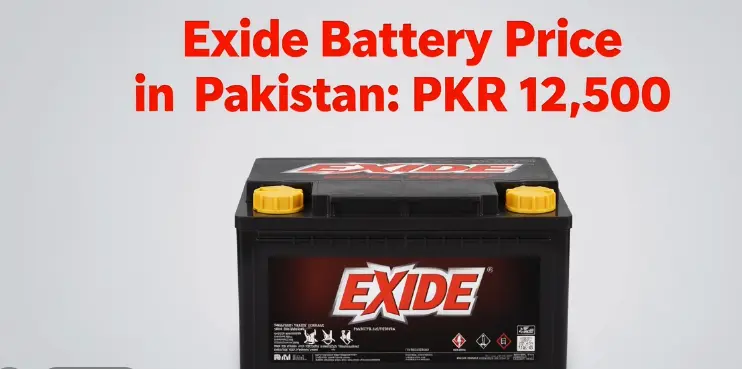
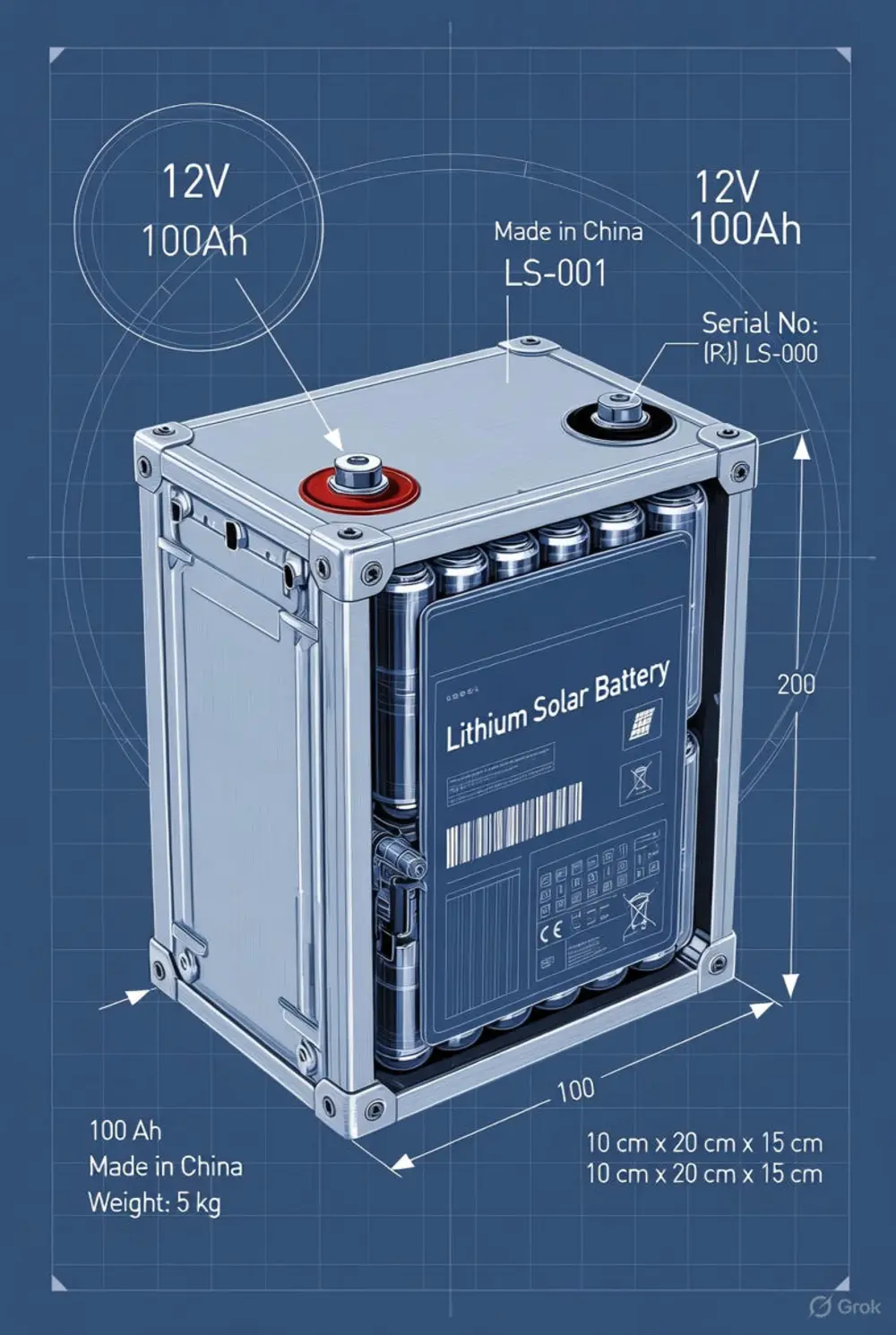
Lithium Battery Price in Pakistan 2026: Complete Buyer’s Guide with Real Market Insights
Last Updated: December 30, 2025
The shift from traditional lead-acid to lithium battery technology has transformed Pakistan’s energy storage market. With load shedding continuing across major cities and solar adoption accelerating, understanding lithium battery prices and specifications has become crucial for Pakistani consumers.
This comprehensive guide provides verified pricing data, technical comparisons, buying recommendations, and answers to the most common questions about lithium batteries in Pakistan’s current market.
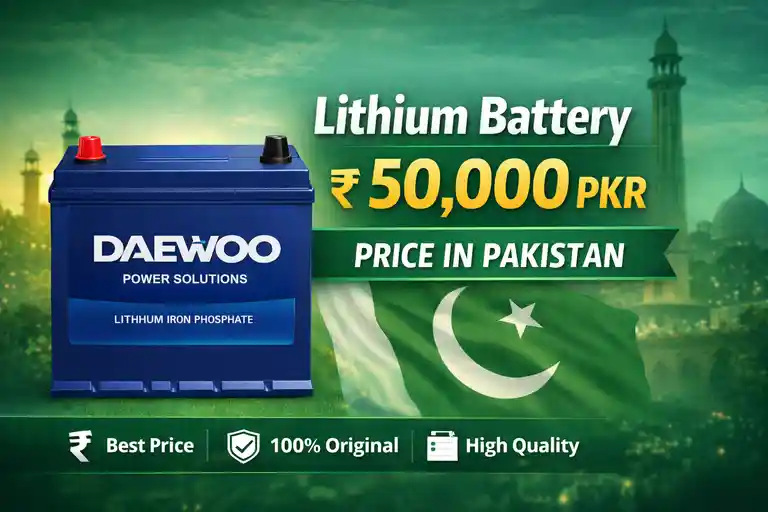
Quick Price Overview: What to Expect in 2026
| Battery Configuration | Capacity Range | Market Price (PKR) | Best Use Case |
|---|---|---|---|
| 12V Lithium Battery | 50Ah | 22,000 – 30,000 | Small UPS, portable devices |
| 12V Lithium Battery | 100Ah | 30,000 – 70,000 | Home backup (1-2 rooms) |
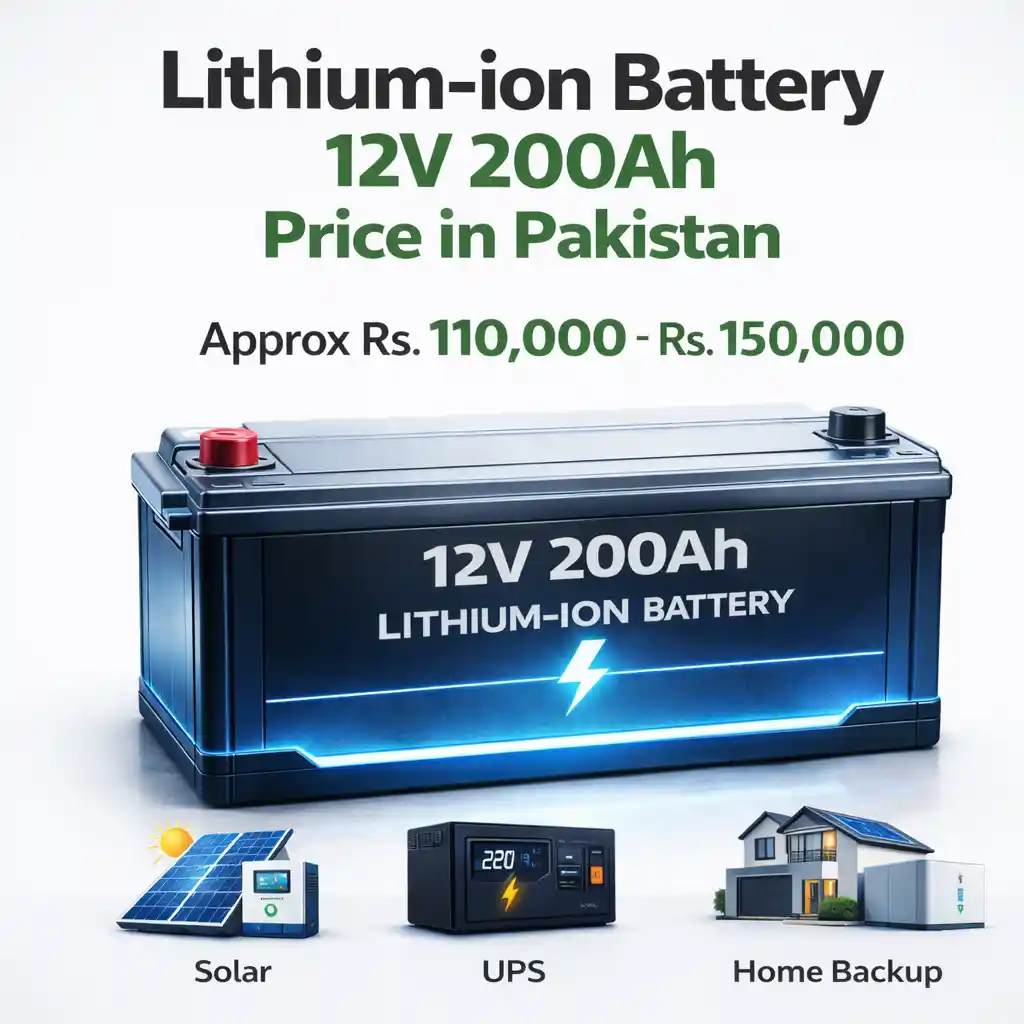
| 12V Lithium Ion | 200Ah | 120,000 – 195,000 | Medium solar systems |
| 24V Solar Battery | 100Ah | 120,000 – 190,000 | Commercial solar setups |
| 48V Lithium Battery | 50Ah | 130,000 – 260,000 | Large inverter systems |
| 48V High-Capacity | 100Ah+ | 300,000 – 550,000 | Industrial & telecom |
| Car Battery (Lithium) | Various | 18,000 – 40,000 | Vehicle starting power |
City-Wise Lithium Battery Price Comparison 2026
Prices vary significantly across Pakistani cities due to transportation costs, market competition, and dealer availability. Here’s a detailed comparison:
12V 100Ah Lithium Battery – City Prices
| City | Price Range (PKR) | Price vs National Avg | Market Status |
|---|---|---|---|
| Lahore | 30,000 – 65,000 | Lowest (-8%) | Highly competitive, best deals |
| Karachi | 32,000 – 68,000 | Average (±0%) | Good availability, varied pricing |
| Islamabad | 35,000 – 72,000 | Higher (+10%) | Growing market, premium dealers |
| Peshawar | 36,000 – 75,000 | Higher (+12%) | Limited dealers, import costs |
| Multan | 34,000 – 70,000 | Slightly Higher (+5%) | Moderate competition |
12V 200Ah Lithium Ion Battery – City Prices
| City | Price Range (PKR) | Price vs National Avg | Best Buying Areas |
|---|---|---|---|
| Lahore | 120,000 – 185,000 | Most Competitive | Hall Road, Township, Ferozepur Road |
| Karachi | 125,000 – 195,000 | Average | Saddar, Malir, North Karachi |
| Islamabad | 135,000 – 205,000 | 10-12% Higher | Blue Area, I&T Centre, PWD |
| Peshawar | 140,000 – 210,000 | 12-15% Higher | Karkhano Market, Saddar |
| Multan | 130,000 – 198,000 | 5-8% Higher | Chowk Bazaar, New Multan |
48V 100Ah Lithium Battery – City Prices
| City | Price Range (PKR) | Availability | Dealer Network |
|---|---|---|---|
| Lahore | 180,000 – 320,000 | Excellent | 50+ authorized dealers |
| Karachi | 185,000 – 340,000 | Excellent | 40+ authorized dealers |
| Islamabad | 200,000 – 360,000 | Good | 25+ authorized dealers |
| Peshawar | 210,000 – 380,000 | Limited | 10-15 dealers |
| Multan | 195,000 – 350,000 | Moderate | 15-20 dealers |
24V 100Ah Solar Battery – City Prices
| City | Price Range (PKR) | Installation Cost | Total Investment |
|---|---|---|---|
| Lahore | 120,000 – 180,000 | 8,000 – 12,000 | 128,000 – 192,000 |
| Karachi | 125,000 – 190,000 | 10,000 – 15,000 | 135,000 – 205,000 |
| Islamabad | 135,000 – 195,000 | 10,000 – 15,000 | 145,000 – 210,000 |
| Peshawar | 140,000 – 200,000 | 12,000 – 18,000 | 152,000 – 218,000 |
| Multan | 130,000 – 188,000 | 8,000 – 12,000 | 138,000 – 200,000 |
Lithium Car Battery – City Prices
| City | Price Range (PKR) | Popular Brands Available | Market Demand |
|---|---|---|---|
| Lahore | 18,000 – 38,000 | AGS, Osaka, Exide, Volta | Very High |
| Karachi | 19,000 – 40,000 | AGS, Osaka, Exide, Phoenix | High |
| Islamabad | 20,000 – 42,000 | AGS, Volta, Exide | High |
| Peshawar | 22,000 – 45,000 | Limited brands | Moderate |
| Multan | 20,000 – 40,000 | AGS, Osaka | Moderate |
Understanding Lithium Battery Technology
Lithium batteries use lithium-ion chemistry to store electrical energy more efficiently than conventional lead-acid batteries. The technology offers several measurable advantages that justify the higher initial cost.
Key Technical Specifications
Energy Density: Lithium batteries store 2-3 times more energy per kilogram compared to lead-acid alternatives. A 100Ah lithium battery weighs approximately 10-15 kg, while an equivalent lead-acid battery weighs 25-35 kg.
Cycle Life: Quality lithium batteries provide 3,000-5,000 charge cycles at 80% depth of discharge. This translates to 8-12 years of practical use versus 2-3 years for lead-acid batteries.
Depth of Discharge: Lithium technology allows 80-100% usable capacity without damage. Lead-acid batteries should only be discharged to 50% to maintain longevity.
Charging Efficiency: Lithium batteries accept charge at 95-98% efficiency and can fully charge in 2-4 hours from solar panels or grid power.
Detailed Price Analysis by Battery Type
12V 100Ah Lithium Battery: The Home Favorite
This configuration dominates residential sales because it perfectly matches typical Pakistani household backup needs.
Price Range: PKR 30,000 – 70,000
What Affects the Price:
- Brand reputation (Chinese brands cheaper, European brands premium)
- Built-in Battery Management System (BMS) quality
- Warranty period (2-year vs 5-year coverage)
- Certification (IEC, CE, ISO compliance)
Backup Calculation Example: A 12V 100Ah battery stores 1,200 watt-hours of energy. This can power:
- 3 LED bulbs (15W each) + 2 ceiling fans (75W each) + 1 LED TV (40W) = 235W load
- Backup time: 1,200Wh ÷ 235W = approximately 5 hours
Best Brands Available:
- Homage (Pakistani assembly, Chinese cells)
- Osaka (budget-friendly option)
- Volta (mid-range performance)
- Canadian Solar (premium tier)
- BYD (industrial quality)
12V 200Ah Lithium Ion Battery: Solar System Standard
The 200Ah capacity has become the benchmark for serious solar installations in Pakistan.
Price Range: PKR 120,000 – 195,000
Why This Capacity Matters: Most Pakistani homes consume 5-8 units (kWh) of electricity daily. A 200Ah battery at 12V provides 2,400Wh or 2.4 kWh storage, enough for overnight backup when combined with daytime solar generation.
Real-World Application: A typical 3-bedroom house in Lahore or Karachi can run essential loads (fans, lights, refrigerator, TV) for 6-8 hours with a 200Ah lithium battery, assuming solar panels charge it during the day.
Installation Considerations:
- Requires 2000W-3000W pure sine wave inverter
- Compatible with 1.5kW to 3kW solar panel arrays
- Needs proper ventilation despite low heat generation
- Should include temperature sensors for Pakistani summers
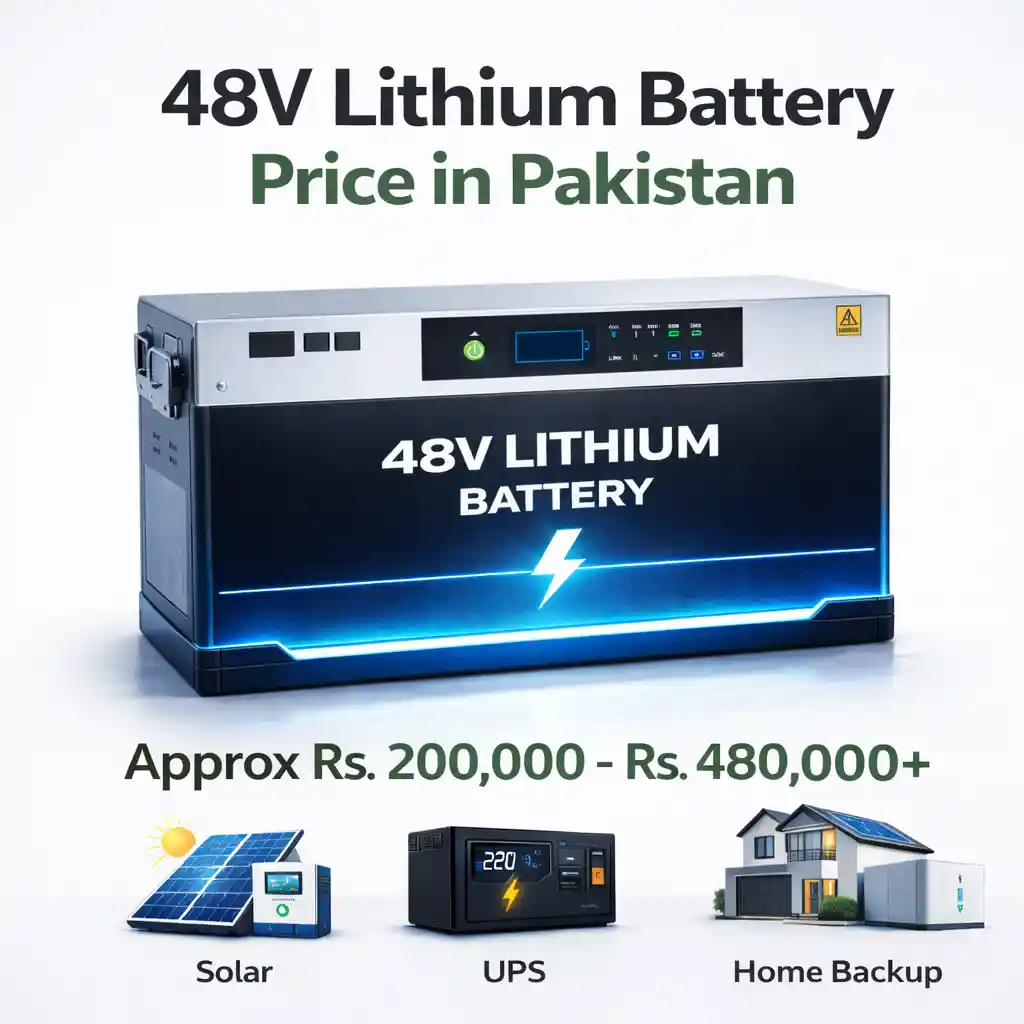
48V Lithium Battery Systems: Professional Grade
High-voltage systems offer superior efficiency for larger installations.
Price Range: PKR 130,000 – 550,000
Technical Advantages:
- Lower current flow means thinner, cheaper wiring
- Better efficiency over longer cable runs
- Reduced power loss (I²R losses drop significantly)
- Compatible with modern hybrid inverters
Typical Applications in Pakistan:
- Commercial buildings with 10kW+ solar arrays
- Telecom towers requiring 24/7 operation
- Agricultural tube wells with solar pumping
- Small factories with critical load backup
- E-rickshaw and electric vehicle charging stations
Configuration Example: A 48V 100Ah battery bank (4,800Wh) can power a 2HP water pump for approximately 6 hours, or provide backup for a small shop with mixed loads throughout the night.
City-Wise Market Analysis
Lahore: Competitive Pricing Hub
Lahore offers some of Pakistan’s most competitive lithium battery prices due to high dealer concentration in areas like Hall Road, Township, and Ferozepur Road.
Average Price Difference: 5-10% lower than other major cities
Market Characteristics:
- Strong competition drives better deals
- Many dealers offer installation services
- Bulk purchase discounts common
- Good availability of Chinese brands
Where to Buy: Hall Road remains the primary electronics market, but newer solar-specific dealers in DHA and Bahria Town often provide better after-sales service.
Karachi: Import Hub with Mixed Pricing
As Pakistan’s main port city, Karachi receives direct imports but prices vary significantly by area.
Price Variability: 10-15% difference between areas
Market Zones:
- Saddar: Traditional electronics market, moderate prices
- Defence/Clifton: Premium dealers, higher prices but better service
- Malir/Landhi: Industrial suppliers, bulk pricing
- North Karachi: Growing solar market, competitive rates
Import Advantage: Some Karachi dealers import directly, offering better prices on premium brands while bypassing distributor markup.
Islamabad: Growing Demand, Premium Pricing
The capital shows increasing solar adoption among residential sectors.
Average Premium: 8-12% higher than Lahore
Market Dynamics:
- Growing environmental awareness
- Government buildings switching to solar
- Blue Area and I&T Centre main commercial zones
- Rising demand in housing societies (Bahria, DHA, PWD)
Regional Cities: Limited Options, Higher Costs
Smaller cities like Multan, Faisalabad, Peshawar, and Quetta face limited availability and 15-20% price premiums.
Challenges:
- Fewer authorized dealers
- Limited brand selection
- Weaker after-sales support
- Transportation costs added to price
Recommendation: Consider purchasing from Lahore or Karachi dealers who offer nationwide delivery and installation.
Solar Integration: Maximizing Your Investment
Matching Batteries to Solar Panel Arrays
Proper system sizing ensures optimal performance and longevity.
Basic Sizing Formula: Daily consumption (kWh) × 1.3 (safety factor) ÷ Battery voltage × 1,000 = Required Ah
Example Calculation:
- Daily use: 6 kWh
- Safety factor: 6 × 1.3 = 7.8 kWh needed
- For 24V system: 7,800 ÷ 24 = 325 Ah required
- Recommended: Two 200Ah batteries in parallel or one 400Ah unit
Inverter Compatibility
Not all inverters work efficiently with lithium batteries.
What to Look For:
- Lithium charging profile support
- Adjustable charging voltage (14.4V-14.6V for 12V batteries)
- Temperature compensation
- BMS communication capability
- Proper voltage range (11V-14.6V for 12V systems)
Compatible Brands in Pakistan:
- Infinisolar
- Voltronic Power
- SMA (premium)
- Growatt
- Must Power
Climate Considerations for Pakistan
Pakistan’s extreme temperatures require special attention.
Summer Strategy (40°C+):
- Install batteries in shaded, ventilated areas
- Avoid direct sunlight exposure
- Consider split AC for battery rooms in extreme cases
- Quality BMS will reduce charging current in high heat
Winter Strategy (5°C-15°C):
- Lithium batteries perform well in cold
- Charging efficiency remains high
- No special heating required in most Pakistani regions
- Himalayan areas may need insulated enclosures
Cost Comparison: Lithium vs Lead-Acid
10-Year Total Cost of Ownership
Many buyers hesitate at lithium prices without calculating long-term costs.
Lead-Acid Battery Path:
- Initial cost: 12V 100Ah = PKR 18,000
- Replacement needed every 2-3 years
- 10-year cost: 18,000 × 4 replacements = PKR 72,000
- Efficiency loss: Additional 15-20% electricity consumption
- Maintenance: Periodic water refills, cleaning
Lithium Battery Path:
- Initial cost: 12V 100Ah = PKR 45,000
- Single purchase for 10+ years
- 10-year cost: PKR 45,000
- Better efficiency: Saves 15-20% on electricity
- Maintenance: Zero
Real Savings: PKR 27,000+ over 10 years, plus convenience and better performance.
Environmental Impact
Lithium batteries reduce environmental footprint significantly.
Advantages:
- No lead contamination risk
- Recyclable materials (over 95% recovery rate)
- Lower carbon footprint due to longevity
- No acid spills or leaks
Buying Guide: What to Check Before Purchase
Essential Features in Quality Lithium Batteries
Built-in Battery Management System (BMS):
- Overcharge protection
- Over-discharge protection
- Temperature monitoring
- Cell balancing
- Short circuit protection
Certification to Verify:
- IEC 62619 (lithium battery safety)
- CE marking (European standards)
- UN38.3 (transport safety)
- ISO 9001 (quality management)
Warranty Terms:
- Minimum 2 years comprehensive
- Premium brands offer 5-10 years
- Check cycle count warranty (usually 3,000+ cycles)
- Understand capacity retention terms (typically 80% after warranty)
Red Flags to Avoid
Warning Signs of Low-Quality Batteries:
- No visible brand markings or model numbers
- Unusually low prices (30%+ below market average)
- No BMS or basic protection only
- Missing certifications or fake certificates
- Vague warranty terms or no warranty card
- Seller cannot provide technical specifications
Common Scams:
- Lead-acid batteries labeled as lithium
- Capacity misrepresentation (100Ah marked as 200Ah)
- Used cells in new casing
- Counterfeit brand logos
Questions to Ask Your Dealer
- What specific cells are used? (Samsung, LG, CATL, EVE are quality brands)
- What is the actual cycle life at 80% DoD?
- Does the warranty cover capacity degradation?
- Is installation included or charged separately?
- What after-sales support do you provide?
- Can I see test certificates?
- Do you have a replacement policy during warranty?
Installation Best Practices
Professional vs DIY Installation
When to Hire Professionals:
- Systems above 5kW
- Multiple battery banks
- Integration with existing solar
- Commercial installations
- When inverter programming is required
Installation Cost: PKR 5,000 – 15,000 depending on system complexity
Safety Requirements
Electrical Safety:
- Use appropriately rated circuit breakers
- Install proper fuses (1.5× battery rated current)
- Ensure correct polarity (reversed connections damage BMS)
- Use tinned copper cables of correct gauge
Physical Safety:
- Secure mounting to prevent vibration
- Ventilated enclosure (despite low gas emission)
- Away from flammable materials
- Accessible for inspection but secure from children
Optimal Location Selection
Ideal Battery Room Conditions:
- Temperature: 15°C – 35°C (use cooling if necessary)
- Humidity: Below 70%
- Ventilation: Natural or forced air circulation
- Dry location away from water sources
- Ground level or basement preferred
- Protection from direct sunlight
Maintenance and Longevity Tips
Minimal Maintenance Requirements
Unlike lead-acid batteries, lithium requires almost no maintenance.
Monthly Checks:
- Visual inspection for physical damage
- Check for unusual heating
- Verify charge/discharge cycles on inverter display
- Clean dust from terminals (if accessible)
Quarterly Checks:
- Verify BMS functionality (check indicators)
- Test voltage levels
- Inspect wiring connections for corrosion
- Update inverter firmware if available
Maximizing Battery Lifespan
Do’s:
- Keep battery 20-80% charged when possible
- Use temperature-controlled environments
- Charge immediately after deep discharge
- Use compatible charging equipment
- Store at 50-60% charge if unused long-term
Don’ts:
- Avoid prolonged storage at 100% or 0%
- Don’t exceed manufacturer’s discharge rate
- Avoid physical shock or vibration
- Don’t expose to extreme temperatures
- Don’t attempt to repair BMS yourself
Performance Monitoring
Modern systems allow detailed monitoring.
Key Metrics to Track:
- Voltage range during charge/discharge
- Number of cycles completed
- Capacity retention over time
- Charging efficiency
- Cell imbalance (if BMS provides data)
Future Outlook: Price Trends for 2025-2026
Expected Market Changes
Downward Price Pressure:
- Increased local assembly reducing import duties
- Growing competition among dealers
- Chinese manufacturers ramping up production
- Technology improvements reducing manufacturing costs
Predicted Price Drop: 10-15% reduction in mid-range batteries by late 2025
Upward Price Pressure:
- PKR devaluation affecting imports
- Global lithium raw material prices
- Increased demand from EV sector
- Potential new taxes on solar equipment
Emerging Technologies
Lithium Iron Phosphate (LiFePO4): Safer chemistry with even longer life (5,000-7,000 cycles) becoming more common in Pakistan. Currently 15-20% more expensive but gaining market share due to superior safety profile.
Sodium-Ion Batteries: Experimental alternatives using abundant materials may enter the market by 2026-2027 at potentially lower prices, though performance remains below lithium-ion.
Conclusion: Making the Right Choice
Investing in lithium battery technology makes economic and practical sense for most Pakistani consumers. While the initial cost appears high compared to lead-acid alternatives, the total cost of ownership, performance advantages, and convenience justify the premium.
Key Takeaways:
For home backup, a 12V 100-200Ah lithium battery paired with appropriate solar panels provides excellent value. The investment pays for itself within 3-4 years through electricity savings and battery longevity.
City dwellers facing frequent load shedding should prioritize quality brands with solid warranties over cheap alternatives. The price difference of PKR 10,000-15,000 becomes insignificant when spread over 10 years of reliable service.
Solar system designers should match battery capacity to actual consumption patterns rather than oversizing. A properly sized 200Ah system outperforms an undersized 300Ah system with inadequate solar charging.
Commercial users should consider 48V systems despite higher initial costs, as efficiency gains and reduced wiring expenses create better long-term value.
Final Recommendation:
Purchase from established dealers offering installation support and clear warranty terms. Verify certifications, test the battery before installation if possible, and ensure your inverter supports lithium charging profiles. The lithium battery market in Pakistan has matured enough that quality options exist across all price points—choose based on your specific needs rather than defaulting to the cheapest option.
With proper selection and installation, your lithium battery investment will provide reliable, efficient power for a decade or more, making it one of the smartest energy decisions for Pakistani households and businesses in 2025.
This guide is updated regularly to reflect current market conditions. Prices vary by region, dealer, and brand. Always verify specifications and warranty terms before purchase.
FAQS
1. What is the price range for lithium batteries in Pakistan?
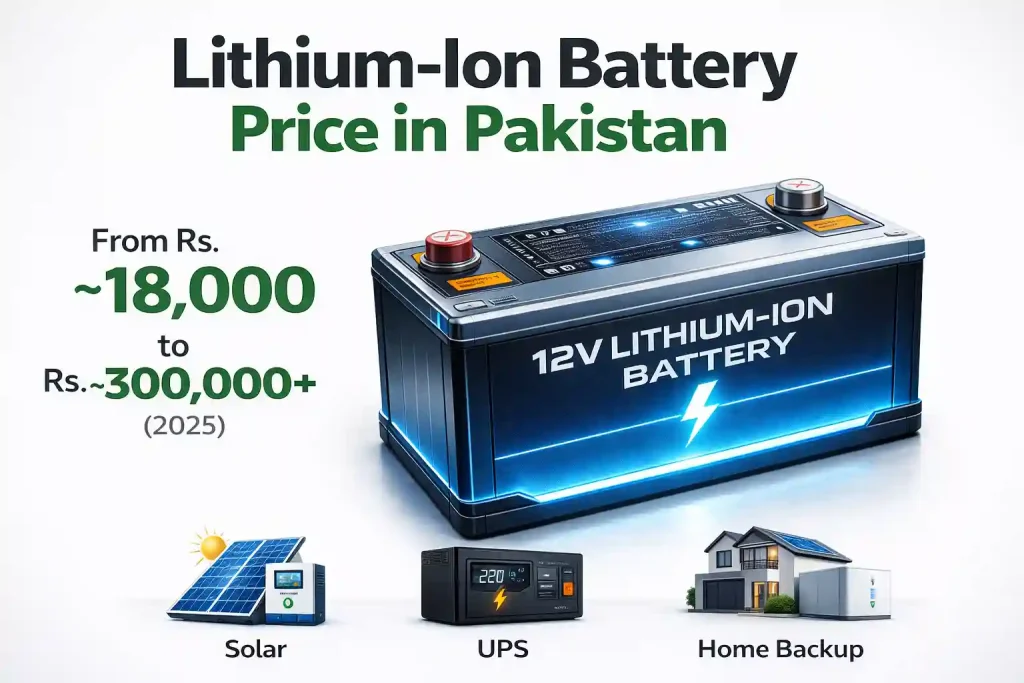
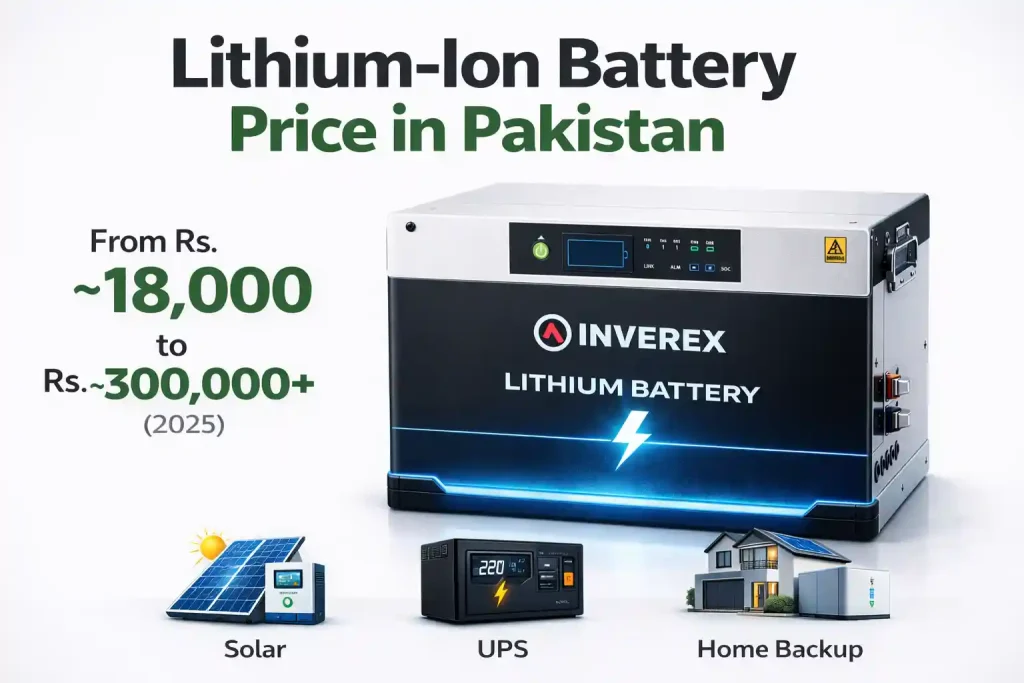
The price of lithium-ion batteries in Pakistan typically ranges from Rs. 18,000 to Rs. 300,000+ depending on the capacity, brand, and features of the battery.
Which brands of lithium batteries are popular in Pakistan?
Some of the popular lithium-ion battery brands in Pakistan include Exide, Volta, Osaka, and Batteries Plus. These brands are known for offering reliable and long-lasting batteries for various uses like solar systems and UPS.
How long do lithium batteries last in Pakistan?
On average, lithium-ion batteries last 5 to 10 years depending on the usage and maintenance. Batteries used for solar systems or home backup can last longer if properly maintained, providing value for the initial investment.
Can I use lithium batteries in a solar power system in Pakistan?
Yes, lithium-ion batteries are widely used in solar power systems in Pakistan due to their efficient energy storage capabilities, longer lifespan, and better performance compared to traditional lead-acid batteries.