Lithium Battery vs Lead Acid Battery for Solar in Pakistan — Which Should You Buy in 2026?
Last Updated: April 2026 | Reading Time: 8 min | Category: Solar Guides
When buying a solar system in Pakistan, most people focus on panels and inverters — and forget that the battery is often the most important decision in the entire system. The wrong battery choice can cost you Rs.100,000–200,000 in replacements within just a few years.
In 2026, Pakistani buyers have two main options: Lithium Iron Phosphate (LiFePO4) batteries and Lead Acid batteries (tubular or AGM). This guide gives you a complete, honest comparison so you can choose the right one for your home, budget, and usage pattern.
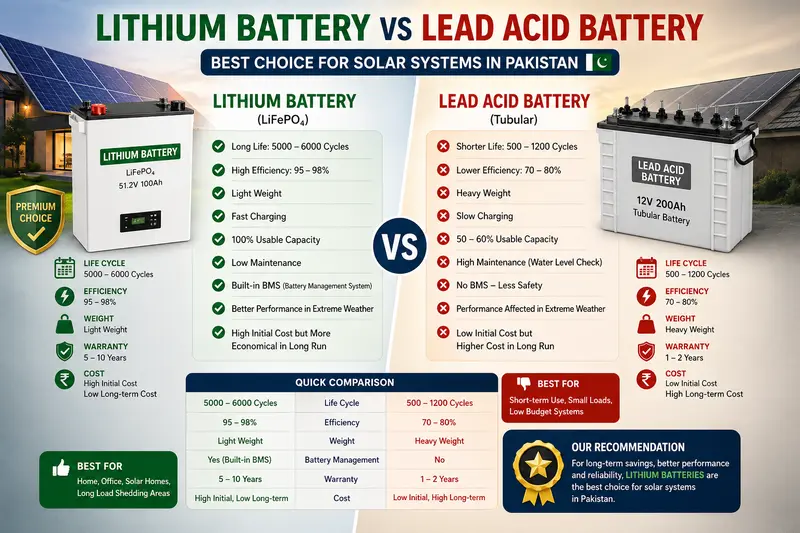
Quick Comparison — Lithium vs Lead Acid at a Glance
| Feature | Lithium (LiFePO4) | Lead Acid (Tubular/AGM) |
|---|---|---|
| Lifespan | 8–15 years | 2–4 years |
| Cycle life | 3,000–6,000 cycles | 300–500 cycles |
| Usable capacity | 80–90% of rated | 40–50% of rated |
| Charging speed | Fast (2–4 hours) | Slow (8–12 hours) |
| Maintenance | Zero | Regular water topping |
| Weight (100Ah) | ~15 kg | ~60 kg |
| Price (100Ah) | Rs.35,000–55,000 | Rs.15,000–25,000 |
| 10-year total cost | Rs.40,000–60,000 | Rs.90,000–150,000 |
| Best for | Daily use, load shedding | Occasional backup only |
Understanding the Two Technologies
Lithium Iron Phosphate (LiFePO4) Batteries
LiFePO4 is a type of lithium battery specifically engineered for energy storage — not to be confused with the lithium-ion batteries in your phone or laptop. LiFePO4 chemistry is significantly safer, more stable in heat, and has a much longer cycle life.
In Pakistan, brands like BYD, Pylontech, CATL, Narada, and Ritar dominate the lithium battery market for solar. Most quality lithium batteries sold in Pakistan come with a built-in Battery Management System (BMS) that protects against overcharging, deep discharge, overheating, and short circuits.
Lead Acid Batteries (Tubular and AGM)
Lead acid is the older, established technology. In Pakistan, tubular lead acid batteries from brands like AGS, Osaka, Phoenix, and Daewoo have been used for UPS backup for decades. They are affordable upfront but require regular maintenance (water topping every 1–2 months) and have a significantly shorter lifespan.
AGM (Absorbent Glass Mat) lead acid batteries are a sealed, maintenance-free version — better than standard tubular but still far behind lithium in lifespan and usable capacity.
Lifespan — The Most Important Factor
This is where the difference between lithium and lead acid is most dramatic — and most misunderstood by Pakistani buyers.
Lithium Battery Lifespan
A quality LiFePO4 battery rated for 3,000–6,000 cycles at 80% depth of discharge will last 8–15 years under daily use in Pakistan. If you charge and discharge once per day (which is typical with load shedding), that is 3,000 days — over 8 years — before the battery reaches 80% of its original capacity.
Lead Acid Battery Lifespan
A tubular lead acid battery is typically rated for 300–500 cycles at 50% depth of discharge. In Pakistan’s load shedding environment, where batteries are cycled daily, this translates to just 2–3 years of useful life before significant capacity degradation.
Many Pakistani households replace their lead acid batteries every 2–3 years without realising that the cost of 4–5 replacements over 10 years far exceeds the upfront cost of a single lithium battery.
Real 10-year cost example for a 200Ah battery bank:
| Lithium (LiFePO4) | Lead Acid (Tubular) | |
|---|---|---|
| Initial purchase | Rs.70,000–110,000 | Rs.30,000–50,000 |
| Replacements in 10 years | 0 | 2–3 times |
| Total 10-year cost | Rs.70,000–110,000 | Rs.90,000–150,000 |
| Maintenance cost | Rs.0 | Rs.5,000–10,000 |
Lithium is cheaper over 10 years despite costing more upfront.
Usable Capacity — You Are Not Getting What It Says on the Box
This is one of the most misunderstood aspects of battery buying in Pakistan.
Lead Acid: Only 40–50% Usable
A 200Ah lead acid battery should never be discharged below 50% — doing so dramatically shortens its life. This means a 200Ah lead acid battery only gives you 100Ah of usable energy in practice.
Lithium: 80–90% Usable
A 200Ah lithium battery can safely discharge to 20% without damage. This means you get 160–180Ah of usable energy from the same 200Ah rating.
In real terms: A 200Ah lithium battery gives you nearly twice the usable backup of a 200Ah lead acid battery of the same rated capacity.
This means when a seller quotes you “200Ah lead acid” vs “200Ah lithium,” they are not comparable products. The lithium battery effectively doubles your backup time.
Performance in Pakistani Heat
Pakistan’s summer temperatures regularly hit 40–48°C, which is brutal for batteries.
Lead acid batteries lose capacity rapidly above 35°C and degrade significantly faster in heat. A battery rated for 3 years in moderate climates may last only 18–24 months in Multan, D.I. Khan, or Interior Sindh. Heat also accelerates water loss, meaning more frequent maintenance is needed.
Lithium LiFePO4 batteries handle heat significantly better. Most quality units operate safely up to 55–60°C and have built-in BMS thermal protection. Capacity loss in heat is much smaller compared to lead acid.
For cities with extreme summer temperatures — Multan, Dera Ismail Khan, Jacobabad, Sibi, Turbat — lithium batteries are strongly preferred.
Charging Speed
During load shedding, electricity availability windows can be short and unpredictable. How quickly your battery charges matters.
Lead acid batteries charge slowly — a full charge takes 8–12 hours. If your power window is only 4–6 hours, your lead acid battery may never fully charge, which further shortens its lifespan (partial charging accelerates sulfation damage).
Lithium batteries charge much faster — typically 2–4 hours for a full charge. Even a short power window or a few hours of strong sunshine is enough to fully recharge the battery, ready for the next outage.
Maintenance
Lead acid batteries require regular maintenance:
- Distilled water top-up every 4–8 weeks (tubular type)
- Terminal cleaning to prevent corrosion
- Equalisation charging every few months
- Keeping them in ventilated areas (they emit hydrogen gas during charging)
Neglecting maintenance is the most common reason lead acid batteries fail early in Pakistan. Many households skip water topping for months, which permanently damages the cells.
Lithium batteries require zero maintenance. No water topping, no equalisation, no terminal cleaning. The built-in BMS handles everything automatically.
Safety
Lead acid batteries emit hydrogen gas during charging — a fire and explosion risk in enclosed spaces. They also contain sulfuric acid, which is corrosive and hazardous. Overcharging or physical damage can cause leaks.
Lithium LiFePO4 batteries are the safest lithium chemistry available. Unlike standard lithium-ion (used in phones), LiFePO4 does not catch fire or explode under normal conditions. They do not emit gases, require no ventilation, and can be safely installed indoors.
Popular Brands Available in Pakistan
Lithium (LiFePO4)
| Brand | Origin | Price Range (100Ah) | Notes |
|---|---|---|---|
| Pylontech | China | Rs.45,000–55,000 | Most popular in Pakistan, excellent BMS |
| BYD | China | Rs.50,000–65,000 | Premium quality, strong warranty |
| CATL | China | Rs.48,000–60,000 | World’s largest battery manufacturer |
| Narada | China | Rs.35,000–45,000 | Budget lithium option, decent quality |
| Ritar | China | Rs.38,000–48,000 | Widely available in Pakistan |
Lead Acid (Tubular)
| Brand | Origin | Price Range (200Ah) | Notes |
|---|---|---|---|
| AGS | Pakistan | Rs.28,000–38,000 | Most widely available local brand |
| Osaka | Pakistan | Rs.25,000–35,000 | Budget option, widely available |
| Phoenix | Pakistan | Rs.27,000–37,000 | Good local option |
| Daewoo | Pakistan | Rs.30,000–42,000 | Decent quality, higher price |
Which Should You Buy?
Buy Lithium if:
- You experience daily load shedding (1–8 hours per day)
- You want a set-and-forget solution with no maintenance
- You are in a hot city (Multan, D.I. Khan, Faisalabad, Karachi)
- You plan to stay in the property for 5+ years
- Budget allows Rs.50,000–120,000 for batteries
- You want the best long-term value
Buy Lead Acid if:
- Load shedding is rare or occasional in your area
- You need the lowest possible upfront cost
- You only need 2–4 hours of occasional backup
- You are renting and will not be in the property long-term
- You are comfortable with regular maintenance
Our Recommendation
For Pakistani households experiencing daily load shedding — which is most of the country in 2026 — lithium LiFePO4 is the smarter investment. The higher upfront cost is recovered within 4–5 years through avoided replacements, and you get significantly better backup, faster charging, zero maintenance, and longer life.
Lead acid still makes sense for very tight budgets or situations where backup needs are minimal. But if you are spending Rs.450,000–750,000 on a complete solar system, saving Rs.30,000–50,000 by choosing lead acid only to replace it every 2–3 years is a false economy.
Frequently Asked Questions
Can I use my existing UPS lead acid battery with a new solar system? Yes, if it is compatible with your inverter’s battery voltage. However, if the battery is more than 2 years old, its capacity will already be significantly reduced. It is better to start fresh with a new battery when installing solar.
Are lithium batteries safe to install inside the house? Yes — LiFePO4 lithium batteries are safe for indoor installation. They do not emit gases and do not require ventilation like lead acid batteries. Many households install them in a utility room or under the stairs.
What size battery do I need for my home? A rough guide: for 4–6 hours of backup running basic lights, fans, and a TV, a 100Ah–150Ah lithium battery is sufficient. For running an inverter AC during outages, you need 200Ah–300Ah minimum. Always ask your installer to do a proper load calculation.
Can I add more batteries later to expand my storage? Yes — most lithium battery systems (especially Pylontech) are designed to be expandable. You can add batteries in parallel as your budget allows. Lead acid can also be expanded but with more limitations.
How do I know if a lithium battery is genuine? Buy from an authorised distributor, ask for the serial number, and verify it on the manufacturer’s website. Pylontech, BYD, and CATL all have online serial number verification tools.
Summary
The lead acid vs lithium decision comes down to one question: are you optimising for lowest upfront cost or lowest total cost over 10 years?
If you experience regular load shedding and plan to use your solar system for the long term, lithium wins decisively — on lifespan, usable capacity, heat performance, charging speed, maintenance, and 10-year economics.
Lead acid remains a valid option for light users with tight budgets, but for most Pakistani households in 2026, lithium LiFePO4 is the right choice.
Check today’s solar system prices including battery options on our Solar Panel Price in Pakistan page — verified daily from wholesale markets.