How to Apply for Net Metering in Pakistan — Step by Step (2026)
Last Updated: April 2026 | Reading Time: 7 min | Category: Solar Guides
If you have installed a solar system — or are planning to install one — net metering is the single most important step to maximise your savings. It allows you to send your extra solar electricity back to the WAPDA grid and get credit on your monthly bill.
This guide explains exactly how net metering works in Pakistan in 2026, which DISCOs support it, what documents you need, and how to complete the application step by step.
What is Net Metering?
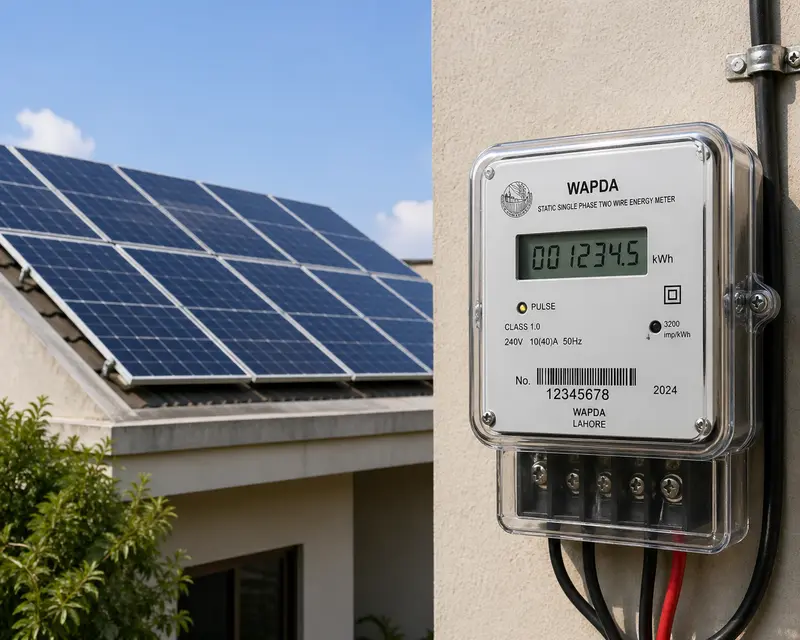
Net metering is a government-approved system that allows solar panel owners to export unused electricity to the national grid. Your electricity meter runs forward when you consume from the grid, and backward when you export solar power. At the end of the month, you only pay for the “net” units — the difference between what you consumed and what you exported.
Example:
- You consumed: 400 units from WAPDA
- You exported: 250 units from solar
- You pay for: 150 units only
In 2026, NEPRA has set the export rate at Rs.19–21 per unit depending on your DISCO. This is lower than your consumption tariff (Rs.60–65/unit), but still significantly reduces your bill.
Which DISCOs Support Net Metering in 2026?
Net metering is now active across all DISCOs in Pakistan:
| DISCO | Area Covered | Approval Time |
|---|---|---|
| LESCO | Lahore & surroundings | 30–45 days |
| IESCO | Islamabad, Rawalpindi | 30–45 days |
| MEPCO | Multan, South Punjab | 45–60 days |
| FESCO | Faisalabad region | 30–45 days |
| GEPCO | Gujranwala region | 30–45 days |
| PESCO | Peshawar, KPK | 45–60 days |
| HESCO | Hyderabad, Sindh | 60–90 days |
| SEPCO | Sukkur, Sindh | 60–90 days |
| QESCO | Quetta, Balochistan | 60–90 days |
Who is Eligible for Net Metering?
To qualify for net metering in Pakistan, you must meet the following conditions:
- You have an existing WAPDA electricity connection
- Your solar system is 1kW or larger
- Your inverter is on NEPRA’s approved inverter list
- Your system is installed by a licensed solar company
- Your system size does not exceed your sanctioned load
Important: Systems with off-grid inverters do NOT qualify. You must use a grid-tied or hybrid inverter from the NEPRA-approved list. Popular approved brands include Huawei SUN2000, Growatt, Solis, Fronius, and SMA.
Documents Required for Net Metering Application
Collect all of these before visiting your DISCO office:
- CNIC copy of the applicant (consumer)
- Latest electricity bill copy (the one showing your reference number)
- Solar installation certificate from your installer
- Single Line Diagram (SLD) of your solar system — your installer prepares this
- Inverter datasheet — must be a NEPRA-approved model
- Form C — Generation License Exemption Form (available at your DISCO office)
- Net Metering Application Form — available at your DISCO office or their website
- Photographs of the installed system — panels, inverter, and meter
- Ownership proof of the property (if you own it) or landlord’s NOC (if renting)
Step-by-Step Application Process
Step 1 — Install Your Solar System
Before applying, your solar system must be fully installed by a licensed installer. Make sure your installer provides you with:
- Installation completion certificate
- System SLD (Single Line Diagram)
- Inverter warranty card and datasheet
Step 2 — Collect All Documents
Gather everything from the list above. Ask your solar installer to prepare the SLD and installation certificate — this is their responsibility. If they refuse, it is a red flag.
Step 3 — Visit Your Local DISCO Office
Go to your nearest DISCO customer service centre and ask for the Net Metering / Generation License Exemption desk. Collect:
- Net Metering Application Form
- Form C (Generation License Exemption Form)
Fill both forms carefully. Your installer can help you fill the technical sections.
Step 4 — Submit Your Application
Submit the completed forms along with all supporting documents at the DISCO office. You will receive an acknowledgement receipt — keep this safely, as it is your proof of submission.
Step 5 — DISCO Inspection
After submission, your DISCO will schedule a site inspection. An engineer will visit your home or business to verify:
- The solar system is properly installed
- The inverter is NEPRA-approved
- The SLD matches the actual installation
- Safety standards are met
This inspection typically happens within 15–30 days of submission.
Step 6 — Bidirectional Meter Installation
After a successful inspection, your DISCO will replace your standard electricity meter with a bidirectional (net metering) meter. This meter can record both import (consumption) and export (solar generation) units separately.
In most DISCOs, the meter is installed within 2–4 weeks after inspection approval.
Step 7 — Start Earning Credits
Once your bidirectional meter is installed and activated, your solar system is officially on net metering. From this point, every excess unit you export is credited at the approved export rate (Rs.19–21/unit in 2026).
How is Your Net Metering Bill Calculated?
Your monthly bill after net metering works like this:
Units consumed from grid × Your applicable tariff slab rate Minus: Units exported to grid × Export rate (Rs.19–21) Plus: Fixed charges, taxes, and meter rent
If your exports exceed your consumption in a given month, the excess credit carries forward to your next bill. It does not expire immediately but the carry-forward policy varies by DISCO — confirm this with your local office.
Common Reasons for Net Metering Application Rejection
Avoid these mistakes that get applications rejected:
- Inverter not on NEPRA approved list — always verify before purchase
- SLD does not match actual installation — get your installer to prepare it carefully
- Incomplete documents — missing one document means starting over
- System size exceeds sanctioned load — check your bill for your sanctioned load before buying
- Unlicensed installer — DISCO may reject if installer is not registered
Tips to Speed Up Your Net Metering Approval
- Apply during off-peak seasons (winter months) when DISCO offices are less busy
- Follow up every 10 days with a call or visit to your DISCO office
- Keep a photocopy of all submitted documents
- Note the name and employee number of the officer who received your application
- For PESCO and QESCO areas, expect slightly longer timelines (60–90 days) — plan accordingly
Net Metering vs No Net Metering — Is It Worth It?
| Without Net Metering | With Net Metering | |
|---|---|---|
| Excess solar power | Wasted | Exported and credited |
| Monthly savings (5kW) | Rs.10,000–15,000 | Rs.18,000–25,000 |
| Payback period (5kW on-grid) | 4–5 years | 2.5–3.5 years |
| Required inverter | Any grid-tied | NEPRA-approved only |
Net metering shortens your payback period by 1–2 years on average. For a 5kW system, that is a saving of Rs.200,000–400,000 over the system’s lifetime.
Frequently Asked Questions
Can I apply for net metering myself without an installer? Technically yes, but not practically. The installer must provide the SLD and installation certificate, which requires technical knowledge. Always use a licensed installer.
What happens if I sell my house after getting net metering? Net metering is linked to your electricity connection, not your name. The new owner can transfer the connection and continue using net metering by notifying the DISCO.
Is there a fee for net metering application? DISCO application processing itself is generally free, but the bidirectional meter installation may have a small cost (Rs.5,000–15,000 depending on DISCO). Confirm with your local office.
My inverter is not on the NEPRA list. What can I do? You cannot use that inverter for net metering. You either need to replace it with an approved model or apply to NEPRA to get your inverter evaluated and added to the list — the second option can take months.
How long is the net metering license valid? Net metering licenses are typically valid for the lifetime of your solar installation, subject to periodic review.
Summary
Net metering in Pakistan in 2026 is accessible, well-structured, and available across all DISCOs. The process takes 45–90 days depending on your area, and the financial benefit is significant — it can cut your electricity bill by 60–80% on a well-sized system.
The key steps are: install your system → collect documents → submit to your DISCO → pass inspection → get your bidirectional meter installed → start earning credits.
If you are planning a new solar installation, make sure your installer commits in writing to completing the net metering application as part of their service. Any reputable solar company in Pakistan will handle this for you.
For current solar panel prices and system costs, visit our Solar Panel Price in Pakistan page — updated daily.