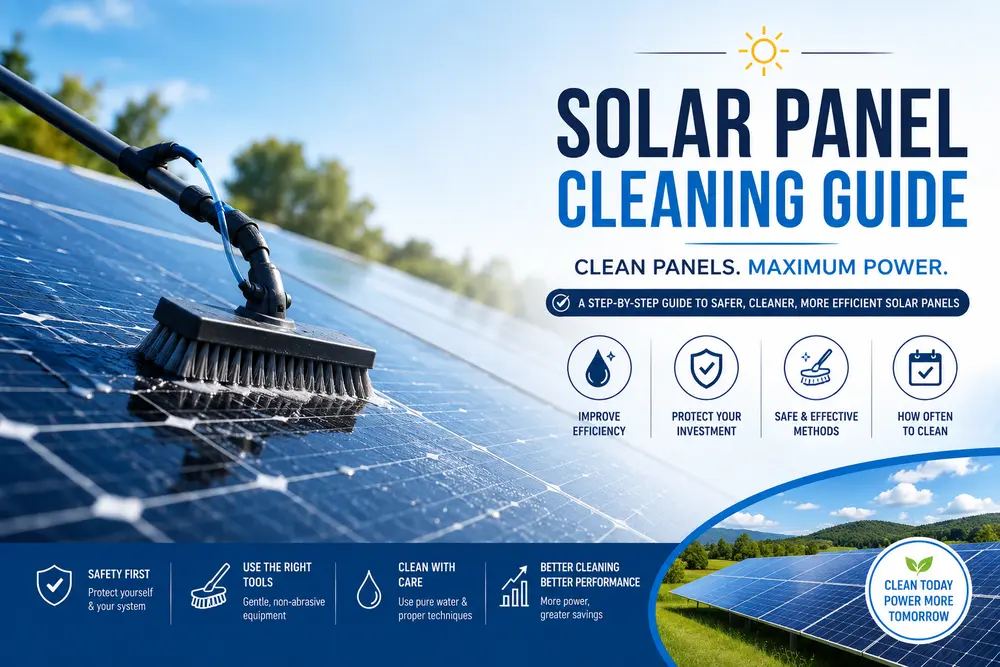
The Complete Solar Panel Cleaning Guide:
Boost Efficiency by Up to 25% in 2026
You spent $15,000–$30,000 on your solar panel system. But if you haven’t cleaned them in the past six months, you could be leaving hundreds of dollars of electricity savings on the table — every single year.
Dust, pollen, bird droppings, and pollution build a film on your panels that blocks sunlight from reaching the photovoltaic cells. According to the National Renewable Energy Laboratory (NREL), soiling alone reduces solar output by 5–25% annually in the United States — with losses jumping to nearly 50% in extreme desert environments.

This guide covers everything you need to know: the right tools, the exact step-by-step process, how to safely clean panels on your roof, and when to call a professional. We’ve researched every top guide on the internet so you don’t have to.
To clean solar panels: Turn off your system → Rinse with a gentle hose → Scrub gently with a soft-bristle brush and mild soapy water → Rinse again with distilled water → Squeegee dry. Do this every 6 months. Never use a pressure washer.
1. Why Cleaning Solar Panels Matters (The Numbers Don’t Lie)
Solar panels work by allowing sunlight to pass through a glass surface and hit the photovoltaic cells beneath. Any layer of dirt, dust, or grime on that glass surface acts like a curtain — it blocks light and directly reduces your electricity production.
Here’s how much efficiency different types of soiling can steal from your panels:
⚡ Efficiency Loss by Contaminant Type
Source: National Renewable Energy Laboratory (NREL), 2024
Real-World Dollar Impact
If your solar system normally generates $1,800 in electricity savings per year and your panels are 20% dirty, you’re losing $360 in savings annually. Over 5 years, that’s $1,800 gone — for the cost of a $30 brush and 45 minutes of your time twice a year.
Does Rain Clean Solar Panels?
This is the #1 myth in solar maintenance. Rain helps — but only for light, loosely attached dust. What rain cannot remove:
- Bird droppings — dried and baked onto hot glass
- Pollen — sticky, waxy coating that rain smears rather than removes
- Hard water deposits — mineral spots left behind when water evaporates
- Industrial soot or pollution near highways and factories
In dry Western states like California, Nevada, Arizona, and Texas, panels can lose significant output within weeks of installation without cleaning — especially during pollen season (March–June) and dry fall months.
2. How Often Should You Clean Solar Panels?
There’s no single universal answer — it depends entirely on your location, environment, and weather patterns. Here is the expert-backed frequency guide for every US homeowner:
Check your solar monitoring app. If your system has a performance tracker (SolarEdge, Enphase, Tesla), watch for gradual output drops over 2–4 weeks. That’s the most reliable sign it’s time to clean — no guesswork needed.
Best Time of Day to Clean
Always clean panels in the early morning (before 9 AM) or late evening (after 6 PM). Here’s why:
- Panels can heat to 100–150°F during peak sun hours. Cold water on hot glass can cause thermal cracking.
- Water evaporates quickly on hot panels, leaving streaks and mineral spots.
- Soap dries and sticks to hot surfaces before you can rinse it off.
- A cool, overcast day is ideal — you get maximum visibility with zero thermal risk.
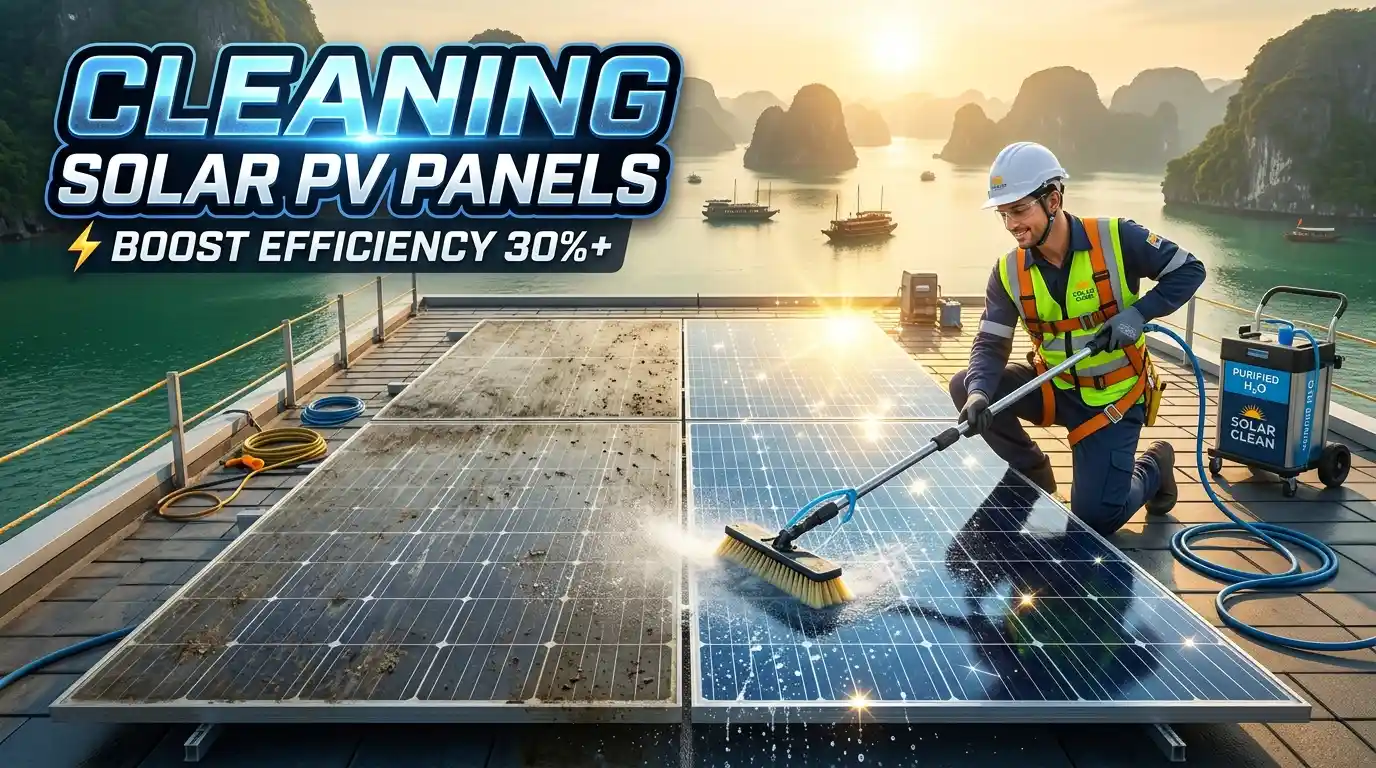
3. Tools & Supplies You Need (Complete Checklist)
You don’t need expensive equipment. The following tools cost $15–$50 total and are everything you need for a professional-quality clean:
Soft-Bristle Solar Brush
The most important tool. Look for non-abrasive bristles on a telescopic handle. Unger, DocaPole, and SunSweep are top brands. ($20–$60)
Garden Hose + Gentle Spray Nozzle
A standard hose on a low-pressure setting is perfect. Never use a pressure washer — it cracks glass and voids warranties.
Mild Dish Soap
Dawn or any non-abrasive dish soap works. Use 1–2 tablespoons per gallon of water. Avoid bleach, ammonia, or industrial cleaners.
Distilled / Deionized Water
Essential for the final rinse. Tap water leaves mineral deposits. Distilled water rinses clean without white spots. ($1/gallon at grocery stores.)
Squeegee or Microfiber Cloth
Removes water after rinsing to prevent streaks and water spots. A window squeegee with a rubber blade works perfectly.
Non-Scratch Sponge
For loosening stubborn spots. Always use the soft side — never the green abrasive Scotch-Brite side, which scratches glass.
Safety Harness + Non-Slip Shoes
Non-negotiable for roof panels. Wet roofs are extremely slippery. A fall protection harness ($30–$80) can save your life.
Vinegar Solution (Optional)
For hard water spots: mix 1 part white vinegar with 1 part distilled water. Apply, wait 2 minutes, rinse. Dissolves mineral deposits effectively.

Pressure washer (cracks glass) · Abrasive scrub pads (scratches anti-reflective coating) · Bleach, ammonia, or acid cleaners (corrodes frames and seals) · Razor blades (permanent scratches) · Steel wool (leaves metal particles that rust) · Tap water alone for final rinse (leaves mineral spots)
4. How to Clean Solar Panels: Step-by-Step Guide
Follow this exact process used by professional solar maintenance technicians. Total time: 30–60 minutes depending on system size.

- 1
🔌 Turn Off Your Solar System
This is a critical safety step. Locate your solar system’s AC/DC disconnect switch (usually near the inverter or main electrical panel) and turn it off. Water and active electrical systems never mix. Allow panels to cool for at least 1–2 hours before touching them with water.
- 2
⛑️ Set Up Safety Equipment
If your panels are on the roof, put on non-slip shoes, set up your ladder at a proper 4:1 angle (1 foot out for every 4 feet up), and attach your safety harness. Never clean alone — have someone nearby in case of an emergency. Clean from the ground using a telescopic pole whenever possible.
- 3
🍂 Remove Loose Debris First
Use your soft-bristle brush (dry) to gently sweep away leaves, twigs, and any large loose debris. Never scrub dry bird droppings — they scratch the glass. Dry debris can also cause micro-scratches if it gets dragged across the surface during a wet wash.
- 4
🚿 Pre-Rinse With Hose Water
Use your garden hose on a low-pressure, gentle spray setting to rinse the entire panel surface. This loosens surface grime and soaks dried bird droppings, making them much easier to remove in the next step without scratching. Work from top to bottom.
- 5
🧼 Scrub With Soapy Water
Mix 1–2 tablespoons of mild dish soap per gallon of water. Dip your soft-bristle brush or non-scratch sponge and scrub the panel surface using gentle circular motions. Apply light pressure — you’re removing a film, not scrubbing a floor. Work in sections, keeping the surface wet at all times.
- 6
💧 Rinse Thoroughly With Distilled Water
Rinse all soap off completely. Soap residue left on panels attracts dirt faster than a bare surface. Use your hose to rinse first, then do a final rinse with distilled or deionized water — this prevents mineral water spots and keeps panels cleaner for longer.
- 7
🪣 Squeegee & Dry
Use a rubber squeegee or microfiber cloth to remove standing water before it evaporates. Work from the top of the panel down in a single stroke. Standing water leaves hard water spots even if you used distilled water for rinsing. In high humidity, this step is especially important.
- 8
🔍 Inspect While You’re Up There
Before climbing down, visually inspect each panel for: cracked glass, discoloration or “hotspots,” loose mounting hardware, damaged wiring, and bird nests underneath. Catching these issues early saves thousands in repair costs. Take photos for your records.
- 9
⚡ Restart Your System & Monitor Output
Turn your solar system back on following your manufacturer’s instructions. Over the next 2–3 days, check your monitoring app. A freshly cleaned system in a dirty environment can show an immediate 10–25% increase in output — that’s your payback signal.
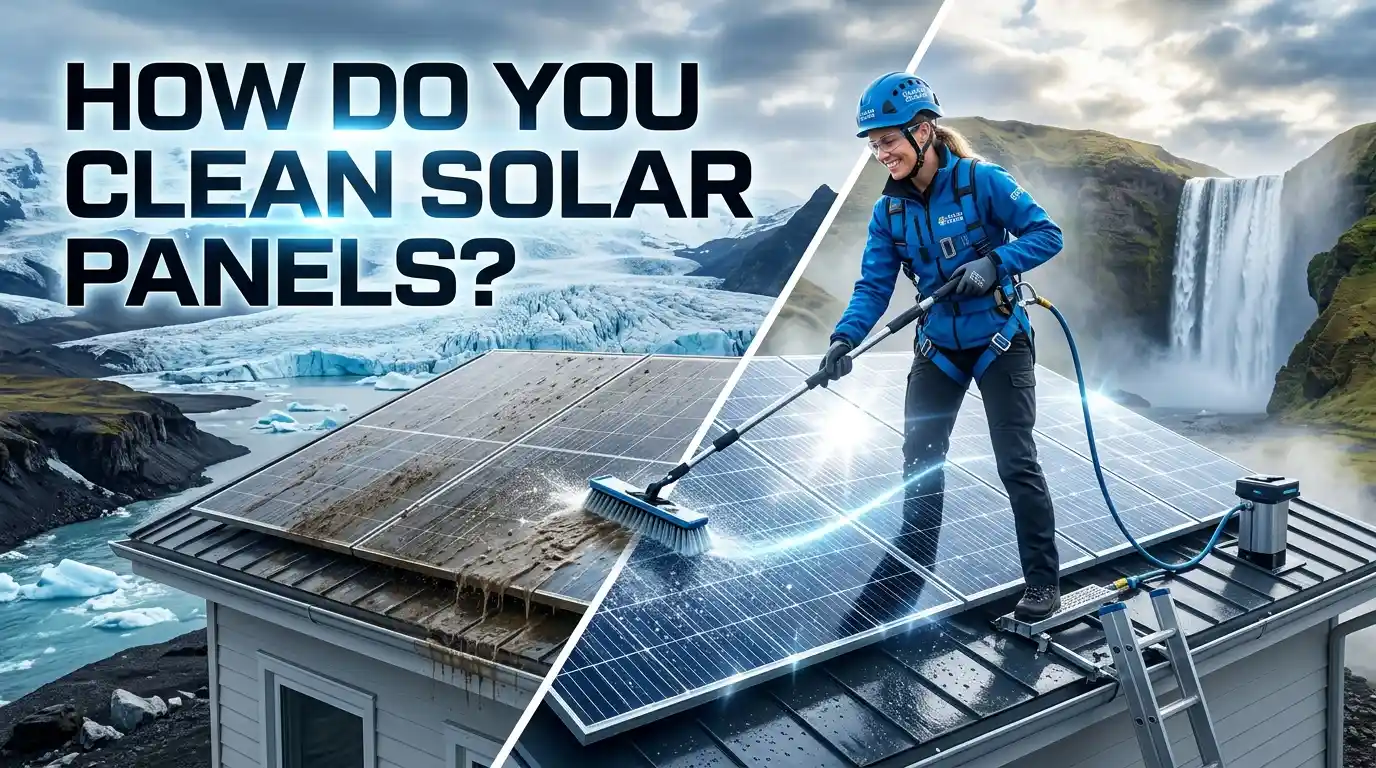
5. Best Brush for Cleaning Solar Panels
The single most important tool for cleaning solar panels is your brush. Using the wrong brush — or scrubbing too hard — permanently scratches the anti-reflective glass coating, which reduces efficiency permanently and may void your warranty.
Here’s what to look for in the best solar panel cleaning brush:
- Soft, non-abrasive bristles: Look for natural or synthetic soft bristles — never hard nylon, wire, or anything labeled “heavy duty.”
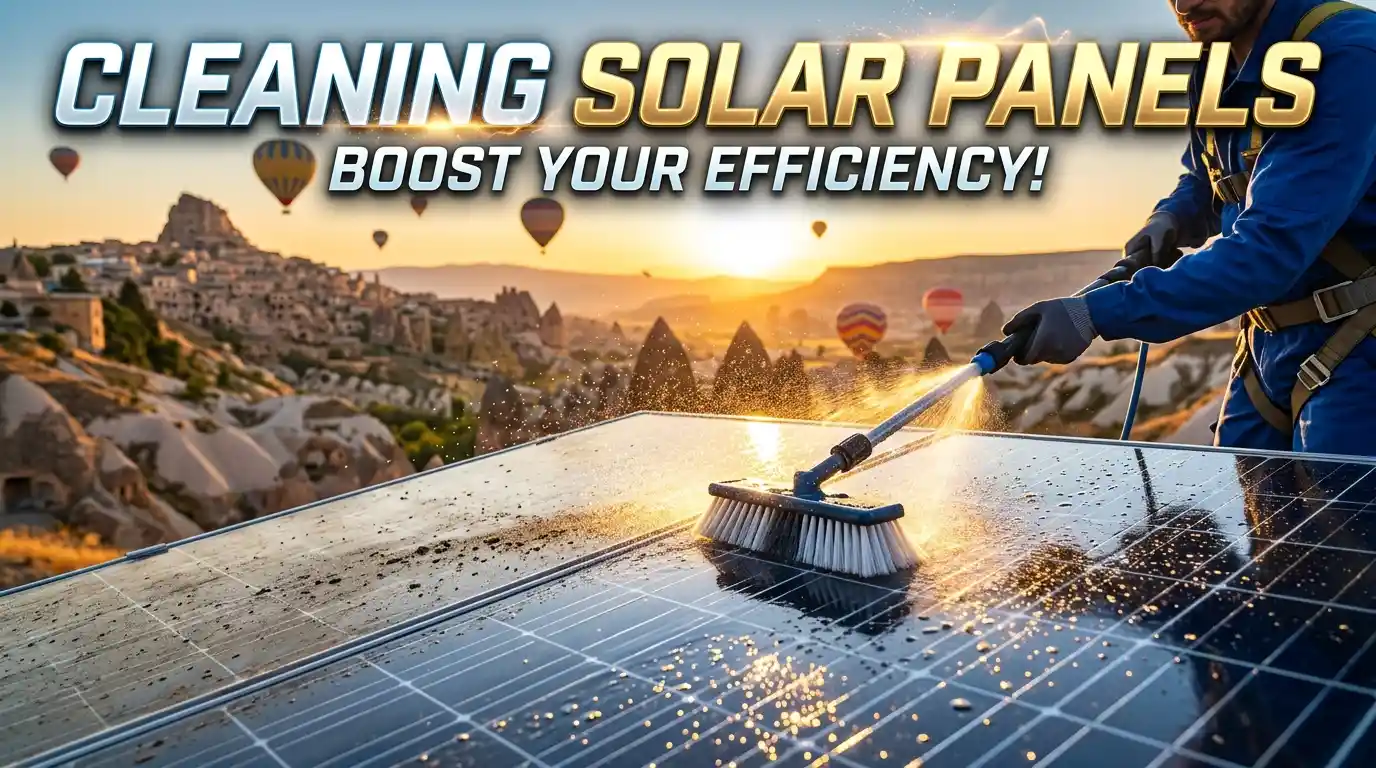
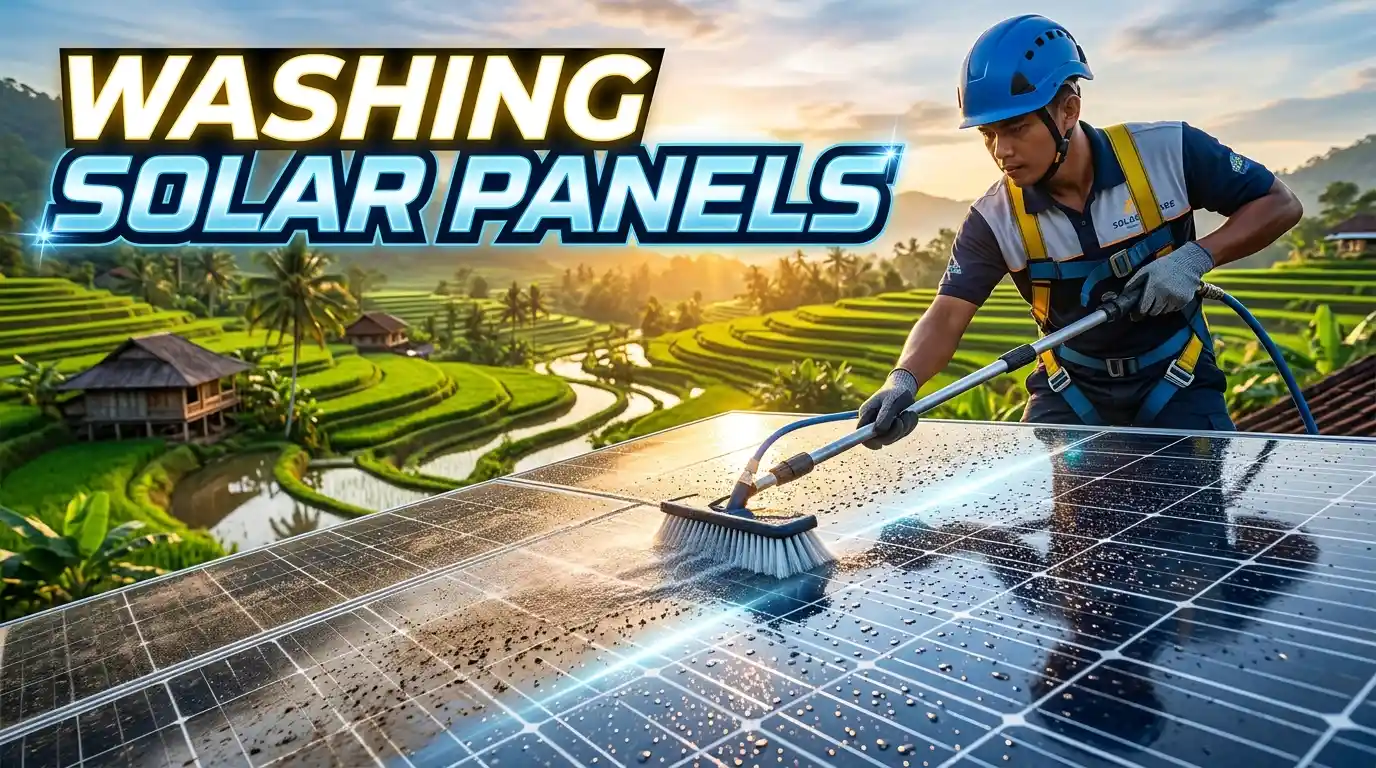
- Long telescopic handle: A 12–30 foot telescopic pole lets you clean roof panels from the ground — the safest approach. Brands like DocaPole and Unger make excellent options.
- Water-fed brush option: Some premium brushes (used by professionals) have a hollow handle with a water inlet — clean water flows through the bristles as you scrub. This gives a superior clean with zero streaks.
- Dual-sided design: Some brushes have a sponge side and a squeegee side on the same tool — convenient for a one-pass clean.
Budget ($15–$25): DocaPole Soft Bristle Brush with telescopic handle — great starter choice.
Mid-range ($40–$70): Unger HydroPower Solar Panel Brush — water-fed, professional quality, no streaks.
Professional ($100+): SunSweep Carbon Fiber Water-Fed Brush — used by solar maintenance companies across the US.
Can I Use a Regular Window Cleaning Brush?
Yes, if the bristles are soft and non-abrasive. Confirm that the brush is rated for glass surfaces and has no metal or hard plastic components that could scratch. When in doubt, buy a brush specifically marketed for solar panels — they’re designed for this exact purpose.
6. How to Clean Solar Panels on a Roof Safely
Cleaning rooftop solar panels adds a significant safety dimension to the task. Falls from roofs are one of the leading causes of home injury deaths in the US. Never take shortcuts with roof safety.
Ground-Level Cleaning (Safest Method)
For most single-story and many two-story homes, a 30-foot telescopic pole lets you clean all panels from the ground. This is the recommended approach for most DIY homeowners. You lose a small amount of scrubbing precision but gain complete safety.
Roof Access Safety Protocol
- Ladder angle: Use the 4:1 rule — for every 4 feet of height, place the base 1 foot from the wall. The top should extend 3 feet above the roof edge.
- Safety harness: Wear an OSHA-approved fall arrest harness anchored to a roof anchor point or structural ridge. Never lean against panels — they can shift.
- Non-slip footwear: Rubber-soled work boots, not sneakers. Wet roofing material is like ice.
- Never work alone: Have a spotter on the ground, ideally someone who can call 911 if needed.
- Avoid steep pitches: Any roof pitch above 6:12 (26.5°) should be left to professionals with proper rigging equipment.
- Never step on panels: They are not designed to bear weight and will crack under foot pressure.
If your roof pitch is steep, your panels are hard to reach, or you feel any discomfort working at height — hire a professional. The cost of a professional cleaning ($150–$300) is a fraction of an ER bill or lost wages from a fall injury. Your safety is never worth the savings.
7. DIY vs. Professional Solar Panel Cleaning: Which Is Right for You?
✅ DIY Cleaning — Pros
- Costs only $15–$30 in supplies
- Clean on your own schedule
- Learn your system better
- Immediate satisfaction + output check
- Great for ground-floor or accessible systems
❌ DIY Cleaning — Cons
- Safety risk on steep or tall roofs
- Wrong technique can scratch glass
- May void warranty if done incorrectly
- Harder to spot hidden damage
- Time-consuming for large arrays
How Much Does Professional Solar Panel Cleaning Cost?
| System Size | Number of Panels | Avg. Professional Cost | DIY Cost | Annual Savings (DIY) |
|---|---|---|---|---|
| Small Home | 8–12 panels | $150–$200 | $15–$25 | $250–$350/yr |
| Average Home | 16–24 panels | $200–$300 | $20–$30 | $340–$540/yr |
| Large Home | 25–40 panels | $300–$500 | $25–$40 | $520–$920/yr |
| Commercial | 50–200+ panels | $800–$3,000+ | N/A (hire pros) | Hire professionals |
When You Should Always Hire a Professional
- Your roof pitch is greater than 6:12 (steeper than 26°)
- You have a 2-story or taller home
- Your system has more than 30 panels
- You notice physical damage (cracks, discoloration) during inspection
- Your system hasn’t been professionally inspected in 3+ years
- You’re uncomfortable working at height — no shame, it’s genuinely dangerous
8. Removing Bird Droppings, Hard Water Spots & Moss
Standard soap-and-water cleaning handles 90% of solar panel soiling. But some stubborn contaminants need special treatment:
🐦 Bird Droppings
Bird droppings are the #1 efficiency-killer for solar panels. They’re concentrated, opaque, and bake hard onto hot glass. A single large dropping can create a “hotspot” that reduces output from an entire panel string.
How to remove: Pre-soak the dropping with warm water for 5–10 minutes to soften it completely. Then gently wipe with a damp microfiber cloth using light pressure. Never scrape dry droppings — this scratches the glass surface permanently.
💧 Hard Water Spots
Hard water spots are white mineral deposits left when tap water evaporates on the panel surface. They’re caused by calcium and magnesium in the water supply.
How to remove: Mix a solution of 1 part white vinegar to 1 part distilled water. Apply to the affected area and let it sit for 2–3 minutes. The mild acidity dissolves mineral deposits. Rinse with distilled water and squeegee dry. For very stubborn spots, commercial solar panel cleaning concentrates with citric acid work well.
🌿 Moss & Algae
Moss and algae appear on panels in heavily shaded areas with poor airflow — often under tree cover. They create a thick, greenish coating that severely blocks sunlight.
How to remove: Apply a diluted isopropyl alcohol solution (1 part 70% IPA to 4 parts deionized water) and scrub with a soft brush. For larger infestations, consult your installer before using any commercial biocide — some chemicals can damage panel seals and frames.
❄️ Snow & Ice
In most cases, you don’t need to remove snow from solar panels — it slides off naturally as it melts, especially since panels are installed at an angle. However, if heavy snow persists and you want to clear it:
- Use a soft foam snow rake with a long handle, available at hardware stores
- Never use metal shovels, brooms, or any hard tool — they’ll crack the glass
- Never chip at ice — wait for temperatures to rise naturally
- Do not climb onto an icy roof under any circumstances
9. 8 Cleaning Mistakes That Void Your Warranty
Solar panel manufacturers specify approved cleaning methods in their warranty documents. Violating these terms can void your warranty — meaning if something goes wrong afterward, you pay out of pocket. Avoid these costly mistakes:
| # | Mistake | Why It’s Dangerous | Warranty Risk |
|---|---|---|---|
| 1 | Using a pressure washer | Cracks tempered glass, forces water into cell connections, strips anti-reflective coating | Voids Warranty |
| 2 | Abrasive scrub pads | Permanently scratches the glass, reducing light transmission forever | Voids Warranty |
| 3 | Cleaning at midday on a hot day | Thermal shock from cold water on 150°F glass can crack the panel or damage seals | May Void Warranty |
| 4 | Leaving soap residue | Soap film attracts dirt 3x faster than clean glass; causes sticky buildup over time | No warranty issue, but costs efficiency |
| 5 | Using bleach, ammonia, or acid cleaners | Corrodes aluminum frames, degrades rubber seals, causes long-term panel degradation | Voids Warranty |
| 6 | Stepping or standing on panels | Panels are not designed for foot traffic; causes microcracks in cells | Voids Warranty |
| 7 | Scraping dry bird droppings | Hard material dragged across dry glass creates permanent micro-scratches | May Void Warranty |
| 8 | Not turning off the system first | Water on active electrical connections is an electrocution hazard | Safety Hazard |
Before cleaning, download your specific panel manufacturer’s maintenance guide. Key brands like Qcells, Canadian Solar, LG, SunPower, REC, and Panasonic each have slightly different recommendations. What works for one brand may void another’s warranty. When in doubt, call your installer.

10. Frequently Asked Questions
📋 Solar Panel Cleaning: Key Takeaways
- Dirty panels lose 15–25% of output — clean them to protect your investment
- Clean twice per year (spring + fall) for most US locations; 4x/year in desert climates
- Always clean in early morning or evening when panels are cool
- Use a soft-bristle brush, mild soap, and distilled water — nothing abrasive
- Never use a pressure washer — it cracks glass and voids warranties
- Turn off your system before any cleaning — it’s a safety requirement
- DIY costs $15–$30 and saves $200–$500 vs. professional cleaning per year
- For steep roofs, large systems, or visible damage — hire a certified professional
Solar Panel Cleaning Service Near Me: City-by-City Guide

Looking for a solar panel cleaning service near me? Pricing and availability varies significantly across the United States. Here is a breakdown of average solar panel cleaning prices by major city and region:
| City / Region | Avg. Cost (Residential) | Per Panel Rate | Top Services Available |
|---|---|---|---|
| San Diego, CA | $180–$280 | $6–$9/panel | Solar panel cleaning San Diego pros widely available |
| Sacramento, CA | $160–$260 | $5–$8/panel | Solar panel cleaning Sacramento — high demand, dusty valley |
| Phoenix, AZ | $150–$250 | $5–$8/panel | Solar panel cleaning Phoenix — quarterly recommended due to dust |
| Murrieta / Temecula, CA | $160–$240 | $5–$8/panel | Solar panel cleaning Murrieta & Temecula — Inland Empire market |
| Eastvale / Menifee, CA | $150–$230 | $5–$7/panel | Solar panel cleaning Eastvale, Menifee, Lake Elsinore, San Jacinto |
| Albuquerque, NM | $140–$220 | $4–$7/panel | Solar panel cleaning Albuquerque — high desert dust environment |
| Delray Beach, FL | $150–$250 | $5–$8/panel | Solar panel cleaning Delray Beach — salt air & humidity buildup |
| Fresno, CA | $150–$240 | $5–$7/panel | Solar panel cleaning Fresno — Central Valley dust & agriculture debris |
To find a solar panel cleaning company near me or solar panel cleaners near me, search Google Maps for “solar panel cleaning [your city]” or ask your original solar installer — many offer maintenance contracts at a discounted rate. Always verify they are licensed, insured, and use professional solar panel cleaning equipment with purified water systems.
Quick formula: Number of panels × $5–$9 = estimated professional cleaning cost. A 20-panel home = $100–$180 per visit. For a solar panel cleaning cost calculator, multiply your panel count by your local per-panel rate, then multiply by 2 (for twice-yearly cleaning) to get your annual maintenance cost. Compare that to your annual energy savings to confirm ROI.
Solar Panel Cleaning Robots, Drones & Automated Systems
The solar industry is rapidly adopting automation for panel maintenance. If you’ve searched for a solar panel cleaning robot or water free cleaning solar panel robots, here’s what’s currently available:
🤖 Solar Panel Cleaning Robots
Automated solar panel cleaning robots are compact devices that sit on your panels and clean them autonomously — no water, no labor. They use dry microfiber brushes or electrostatic technology to remove dust without scratching the glass.
- Best for: Large residential arrays (20+ panels), commercial installations, and people who want hands-off maintenance
- How they work: The robot drives along a track system or uses panel edges as guides, sweeping dust off the surface. Some models operate on timers; others are app-controlled.
- Water-free models: Water free cleaning solar panel robots are ideal in drought-prone areas (Arizona, Nevada, California) where water conservation is important and dust is the primary contaminant.
- Cost: Consumer robots range from $300–$1,500. Commercial-grade systems cost $3,000–$20,000+ for large arrays.
- Popular brands: Ecoppia, Airtouch Solar, Serbot, Gekko Systems
🚁 Drone Cleaning Solar Panels
Drone cleaning solar panels is an emerging professional service primarily used for commercial and utility-scale installations. Solar panel cleaning drones carry water tanks and rotating brush attachments, covering large arrays far faster than ground crews.
- A drone can clean a 1-megawatt commercial array in hours vs. days for a human crew
- For residential systems, drone cleaning is not yet cost-effective — stick with manual or robot options
- Some companies now offer drone inspection + cleaning as a combined service
🚿 Solar Panel Washing Machine / Automated Systems
A solar panel washing machine refers to fixed automated cleaning systems installed on large commercial or industrial arrays. These systems use a solar panel cleaning machine on rails that runs across the panel array on a schedule, using recirculated purified water and soft brushes.
Best Solar Panel Cleaning Products, Kits & Solutions
The market for solar panel cleaning products has expanded significantly. Here’s what works and what to skip:
Solar Panel Cleaning Kits
Solar panel cleaning kits bundle everything you need: a soft brush, squeegee, microfiber cloths, and a cleaning solution — sold together for convenience. They range from $25–$80 and are a great starting point for new solar owners. Look for kits that include a telescopic pole handle for safe reach.
| Product Type | Best For | Avg. Price | Recommended? |
|---|---|---|---|
| Solar panel cleaning kit (brush + squeegee + cloth) | DIY homeowners | $25–$60 | ✅ Yes |
| Solar panel cleaner solution (spray concentrate) | Stubborn grime, pollen | $15–$30 | ✅ Yes |
| Deionized water system (DI filter) | Hard water areas | $40–$120 | ✅ Yes — worth it |
| Solar panel cleaning clip / panel edge clamp | Securing cleaning tools | $10–$25 | Situational |
| Pressure washer attachment | — | — | ❌ Never use |
Best Solar Panel Cleaner Solution
The best solar panel cleaner solution is either:
- DIY: 1–2 tbsp mild dish soap (Dawn) per gallon of distilled water. Cheap, effective, and panel-safe.
- Commercial: A pH-neutral, non-ionic solar panel cleaning solution like Brite Labs or Solar Brite. These are formulated to clean without leaving residue and won’t harm anti-reflective coatings.
- Hard water spots: 50/50 white vinegar + distilled water. The acidity dissolves calcium deposits safely.
Deionized Water for Cleaning Solar Panels
Using deionized water for cleaning solar panels is the professional standard. Deionized (DI) water has all mineral ions removed, so it leaves zero residue when it evaporates — no spots, no streaks. You can buy DI water in jugs ($1–$2/gallon), or install a small DI filter on your hose ($40–$120) for unlimited spot-free rinsing. In hard water regions, this single upgrade dramatically improves cleaning results.
Benefits of Cleaning Solar Panels Regularly
Still wondering if cleaning is worth the effort? Here are the proven benefits of cleaning solar panels:
- Immediate output boost: A single cleaning session in a dusty environment can increase energy production by 10–25% overnight.
- Faster ROI: Every percentage point of efficiency recovered translates directly to more electricity savings, shortening your payback period.
- Extended system lifespan: Bird dropping hotspots and soiling-caused thermal stress degrade solar cells permanently. Clean panels last longer.
- Warranty protection: Many manufacturers require documented routine maintenance for warranty claims to remain valid.
- Early damage detection: Cleaning is the best opportunity to spot cracks, loose wiring, and pest damage before they become expensive problems.
- Commercial solar panel cleaning benefits: For businesses, clean panels mean predictable energy output for financial planning and sustainability reporting.
How to Clean Solar Panels on Garden Lights
Small solar light panels on garden lights, path lights, and security lights also need regular cleaning. Here’s how to clean solar panels on garden lights:
- Remove the solar light from its stake or mounting point
- Wipe the small solar panel with a damp microfiber cloth and a drop of mild soap
- Rinse with a damp clean cloth — no hose needed for small garden panels
- Dry completely before reinstalling to prevent water ingress
- Clean every 2–3 months for best performance, or whenever lights seem dim
Dirty solar garden lights are one of the most common reasons they stop working — before replacing batteries or the unit, always try cleaning the panel first.
Commercial Solar Panel Cleaning
Commercial solar panel cleaning for businesses, warehouses, industrial buildings, and solar farms requires a different approach than residential cleaning:
- Scale: Commercial arrays have 50–5,000+ panels across large roof areas or ground-mount systems. Manual cleaning requires professional crews with specialized equipment.
- Frequency: Most commercial operators clean quarterly or monthly in dusty regions — the ROI justifies frequent cleaning at commercial production levels.
- Equipment: Professional solar panel cleaning equipment for commercial use includes water-fed pole systems with deionized water tanks, automated robotic cleaners on rail systems, and drone cleaning services.
- Solar panels for industrial buildings: Large flat-roof industrial installations accumulate more dust than angled residential arrays. Ground-level maintenance is easier but requires more thorough equipment.
- Starting a solar panel cleaning business: The solar panel cleaning business market is growing rapidly as solar adoption expands. Startup costs are low ($2,000–$5,000 for equipment), demand is recurring, and the skill barrier is accessible. Many operators target commercial clients for higher contract values.