Solar Panels Series vs Parallel:
Which Wiring Is Better? (2026 Guide)
The question of solar panels series vs parallel — or as many people search it, solar panels serial or parallel — is one of the most important decisions in any DIY solar build. Get it right and your system charges efficiently, runs smoothly, and maximizes every watt your panels produce. Get it wrong and you’re leaving power on the table, stressing your charge controller, or creating a safety hazard.
This guide gives you a definitive answer — with real numbers, wiring diagrams, and specific recommendations for 2-panel, 4-panel, RV, and home solar systems.
Use series if you have an MPPT controller, long cable runs, or a grid-tied system. Use parallel if you have a 12V battery bank, a PWM controller, or shading issues. Use series-parallel for 4+ panels — it’s the best of both worlds and the standard for most modern systems.
1. Quick Answer: Series or Parallel Solar Panels?
Before diving into the details, here is the decision framework most solar professionals use:
| Your Situation | Best Wiring | Reason |
|---|---|---|
| MPPT charge controller | Series or Series-Parallel | MPPT works best with higher voltage input |
| PWM charge controller | Parallel | PWM needs voltage close to battery voltage |
| 12V battery system | Parallel | Keeps system at 12V to match battery |
| 24V or 48V battery system | Series | Series strings reach correct system voltage |
| Roof shading present | Parallel or microinverters | Parallel isolates shaded panels |
| Long cable runs (30ft+) | Series | Higher voltage = less current = thinner wire |
| Grid-tied system | Series | String inverters require 250–600V input |
| 4+ panels, any system | Series-Parallel | Best balance of voltage, current & shade tolerance |
| RV / van 12V build | Parallel | Match 12V battery bank, shade tolerant |
| Off-grid cabin (larger) | Series-Parallel | Optimize for MPPT with multiple panels |
2. Solar Panels in Series: How It Works
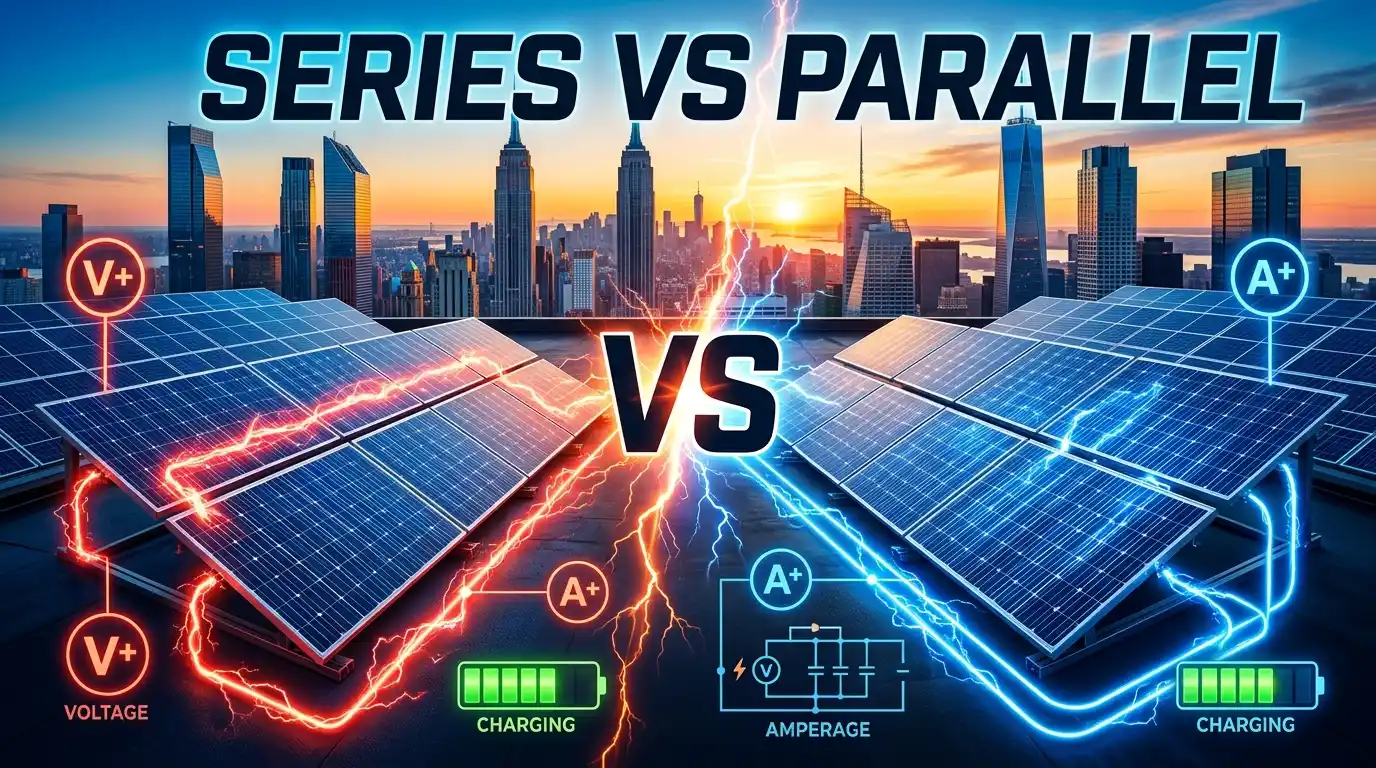
Solar panels in series means connecting them end-to-end: the positive (+) terminal of one panel connects to the negative (−) terminal of the next. Think of it like batteries in a TV remote — they stack their voltages.
Current Stays Same
Voltage: 30+30+30 = 90V
Current: stays at 10A
Total Power: 90V × 10A = 900W
- Connect: (+) of Panel 1 → (−) of Panel 2
- Free (−) of Panel 1 = string negative
- Free (+) of last panel = string positive
Voltage Stays Same
Voltage: stays at 30V
Current: 10+10+10 = 30A
Total Power: 30V × 30A = 900W
- Connect: all (+) together, all (−) together
- Use MC4 Y-branch connectors
- Add inline fuse per panel (3+ panels)
Series Wiring Diagram
Free (−) of Panel 1 ──────────────────────────── Free (+) of Panel 3
↓ String Negative ↓ String Positive
[MPPT Charge Controller]
Result: Voltage triples, Amps stay the same
Advantages of Solar Panels Connected in Series
- Higher voltage → thinner, cheaper wire: Higher voltage means lower current for the same wattage. Lower current lets you use 10 AWG instead of 6 AWG — saving significant money on long runs.
- MPPT efficiency: MPPT controllers deliver 10–30% better performance when given a high-voltage input well above battery voltage. Series configurations require MPPT charge controllers but deliver 10–30% better efficiency than PWM systems.
- Grid-tie compatible: Modern string inverters require 250–300V minimum start voltage, making series wiring mandatory for grid-connected systems.
- Cold weather performance: Panel voltage rises in cold weather — series strings safely accommodate this voltage increase within MPPT controller limits.
- Simpler wiring for long runs: One pair of wires carries the full string output at high voltage — easier to route than multiple parallel runs.
Disadvantages of Series Wiring
- Shade sensitivity — the “Christmas light effect”: Because all the panels in a string share a single current path, the entire string’s performance is limited by the output of the lowest-performing panel. One shaded panel hurts all panels in the string.
- Requires MPPT controller: A PWM controller cannot handle the high voltage of a series string safely.
- Higher voltage = higher electrical hazard: Series strings can reach 300–600V DC — dangerous if mishandled. Always de-energize before working on wiring.
- Panel mismatch is more harmful: If one panel in a series string is older, dirtier, or a different wattage, it constrains every other panel’s output.
3. Solar Panels in Parallel: How It Works
Solar panels in parallel means connecting all positive terminals together and all negative terminals together. Like lanes merging on a highway — more capacity, same speed (voltage).
Parallel Wiring Diagram
[Panel 2 +]──┤ MC4 Y-Connector ──── Combined (+) ──▶ [Charge Controller +]
[Panel 3 +]──┘
[Panel 1 −]──┐
[Panel 2 −]──┤ MC4 Y-Connector ──── Combined (−) ──▶ [Charge Controller −]
[Panel 3 −]──┘
Result: Amps triple, Voltage stays same
Advantages of Solar Panels Wired in Parallel
- Shade tolerant: A shaded or underperforming panel only reduces its own output — other panels keep producing at full capacity independently.
- Lower, safer voltage: Parallel systems stay at panel voltage (typically 18–40V) — safer for DIYers and compatible with low-voltage battery systems.
- PWM controller compatible: Parallel wiring maintains the correct voltage for PWM charge controllers.
- Mixed panel wiring: Different panel brands or wattages work better in parallel since each operates independently — though mixing panels is generally not recommended.
- Ideal for 12V systems: RV, van, and small cabin systems running 12V batteries need parallel wiring to maintain the correct system voltage.
Disadvantages of Parallel Wiring
- High current needs thick, expensive wire: Combining currents of 4×10A panels = 40A total. This requires 6 AWG or even 4 AWG cable — significantly more expensive than series wiring wire.
- More complex connections: Multiple Y-branch connectors and a combiner box are needed for 4+ panels in parallel.
- Higher fusing requirements: Each panel needs its own inline fuse in a parallel system to prevent backfeed — more components, more cost.
- Less efficient with MPPT: Parallel systems feed low voltage into the MPPT controller, which has less “headroom” to optimize — resulting in lower efficiency vs. series wiring.
4. Solar Panel Series vs Parallel: Complete Comparison Table
Here is the definitive series vs parallel solar panels comparison — covering every factor that matters for US homeowners and DIY solar builders:
| Factor | Series Wiring | Parallel Wiring |
|---|---|---|
| Voltage effect | Voltages add (e.g., 3×30V = 90V) | Voltage stays same as 1 panel (30V) |
| Current (amps) effect | Amps stay same as 1 panel (10A) | Amps add (e.g., 3×10A = 30A) |
| Total power output | Same (900W) | Same (900W) |
| Required charge controller | MPPT only | PWM or MPPT |
| Wire gauge needed | 10–12 AWG (low current) | 6–8 AWG (high current) |
| Shade tolerance | Poor — one shaded panel hurts all | Excellent — panels independent |
| 12V battery system | Not compatible (too high voltage) | ✅ Ideal |
| 24V / 48V system | ✅ Ideal | Requires 24V/48V rated panels |
| Grid-tie inverter | ✅ Required | Not compatible (too low voltage) |
| Long cable runs | ✅ Better (less current loss) | Needs thick expensive wire |
| Safety | Higher voltage hazard (300–600V) | Safer (18–40V typical) |
| Real-world efficiency | Higher with MPPT (10–30% more) | Lower with MPPT (less headroom) |
| Best for | Grid-tied, MPPT off-grid, large systems | RV, van, 12V cabin, shaded roofs |
Neither series nor parallel produces more total watts — both configurations from the same panels produce identical wattage under perfect conditions. The difference is how that power is delivered and how efficiently your controller handles it in real-world conditions.
5. Solar Panels in Series and Parallel (Series-Parallel)
Solar panels in series and parallel — often called series-parallel or hybrid wiring — combines both methods for the best of both worlds. For installations with 6+ panels, combining both wiring methods balances voltage and current requirements while maintaining system reliability. This approach is becoming the standard for residential and commercial installations in 2026.
How Series-Parallel Works
Panels are first grouped into series strings (to raise voltage), then those strings are connected in parallel (to raise current). The naming convention uses “S” for series and “P” for parallel:
String 2 (series): [Panel 3: 30V/10A]──(series)──[Panel 4: 30V/10A] = 60V / 10A
Strings in parallel: String 1 (+) ──┐ String 1 (−) ──┐
String 2 (+) ──┘─▶ Ctrl (+) String 2 (−) ──┘─▶ Ctrl (−)
Final output: 60V / 20A / 1200W
(vs single panel: 30V / 10A / 300W)
Common Series-Parallel Configurations
| Config | Panels | Voltage | Current | Total Power* | Best For |
|---|---|---|---|---|---|
| 2S1P | 2 | 60V | 10A | 600W | 24V MPPT system |
| 2S2P | 4 | 60V | 20A | 1,200W | 24V MPPT, medium cabin |
| 3S2P | 6 | 90V | 20A | 1,800W | 48V MPPT off-grid |
| 4S3P | 12 | 120V | 30A | 3,600W | Large off-grid home |
| 10S2P | 20 | 300V | 20A | 6,000W | Grid-tied string inverter |
*Based on 300W / 30V / 10A panels for illustration
6. Solar Panels in Series or Parallel with MPPT Controller
Your choice of charge controller is the single biggest factor in the series vs parallel decision. Specifically, the question of solar panels in series or parallel with MPPT has a clear answer from the industry.
Why MPPT Controllers Prefer Series Wiring
MPPT controllers operate most effectively with a significantly higher input voltage from the solar array than the battery bank voltage — a scenario perfectly created by series wiring.
Here’s the technical reason: An MPPT controller’s job is to find the “maximum power point” on the panel’s voltage-current curve — the sweet spot where the panel produces peak wattage. The more voltage headroom the controller has above the battery voltage, the wider its operating range and the better it performs during:
- Morning and evening hours (low-angle sunlight)
- Cloudy or overcast conditions
- Hot summer days when panel voltage naturally drops
- Cold weather when panel voltage rises above rated specs
MPPT controllers deliver 10–30% better efficiency than PWM systems. The higher upfront cost is offset by superior low-light performance and simplified wiring, especially in cold climates and long cable runs. For a 1,000W system generating $1,500/year in savings, that’s an additional $150–$450/year — meaning a $150 MPPT controller pays for itself in the first year.
Minimum Series Voltage for MPPT Controllers
| Battery System | Min MPPT Input Voltage | Recommended Array Voltage | Series Config Example |
|---|---|---|---|
| 12V battery | ~18V minimum | 36–72V (2–4 panels in series) | 2S (two 20V panels) |
| 24V battery | ~36V minimum | 60–100V (2–4 panels in series) | 2S or 3S |
| 48V battery | ~60V minimum | 100–150V (3–5 panels in series) | 3S or 4S |
| Grid-tied (no battery) | 250–300V minimum | 300–600V (8–15 panels in series) | 10S–15S per string |
Panel voltage rises in cold weather — sometimes 10–20% above the rated Voc. Always check that your maximum series string voltage (Voc × number of panels × 1.25 cold weather factor) does not exceed your MPPT controller’s maximum input voltage rating. Exceeding the controller’s max voltage permanently damages it.
7. 2 Solar Panels: Series or Parallel?
For exactly 2 solar panels in series vs parallel — the decision comes down to your battery voltage and controller type:
- You have a 24V battery bank
- You use an MPPT charge controller
- Your cable run is 20+ feet
- You have a grid-tied system (part of a larger string)
Perfect for 24V MPPT input
- You have a 12V battery bank (RV, van, boat)
- You use a PWM charge controller
- One panel may be shaded frequently
- Your cable run is under 15 feet
Matches 12V battery charging
8. 4 Solar Panels in Parallel or Series? (Best Answer)
For 4 solar panels in parallel vs series vs series-parallel — the answer for most systems is series-parallel (2S2P). Here’s why each option plays out:
Option A: All 4 in Series (4S)
- Output: 4× voltage, same amps → very high voltage (120V+ for standard panels)
- Good for: 48V battery bank with MPPT, or as part of a grid-tied string
- Risk: Voltage may exceed some MPPT controller maximum inputs on 12V/24V systems
Option B: All 4 in Parallel (4P)
- Output: same voltage, 4× amps → high current (40A+)
- Good for: 12V systems, PWM controllers, heavy shading
- Downside: Requires 4 AWG wire or larger — expensive. Each panel needs its own inline fuse.
Option C: 2 Series Strings in Parallel — 2S2P (Recommended)
- Output: 2× voltage, 2× amps → balanced for MPPT
- Good for: 24V–48V MPPT systems, most residential off-grid builds
- This is the recommended configuration for most 4-panel systems — it gives MPPT enough voltage headroom without going dangerously high, uses moderate wire gauge (10 AWG), and provides better shade tolerance than pure series.
For 4 panels with a 24V MPPT system: use 2S2P. For 4 panels with a 12V battery and PWM controller: use 4P parallel. For 4 panels going into a grid-tied string inverter: use 4S series or combine with other panels for the required voltage window.
9. How to Connect Solar Panels in Series and Parallel (Step-by-Step)
How to Connect Solar Panels in Series
- Lay out your panels face-down or face-up in a safe area. Identify the positive (red/+) and negative (black/−) MC4 connectors on each panel lead.
- Connect Panel 1 (+) to Panel 2 (−): Plug the male MC4 positive connector of Panel 1 into the female MC4 negative connector of Panel 2. Push until you hear a click — this is the lock engaging.
- Continue the chain: Connect Panel 2 (+) to Panel 3 (−), and so on for additional panels in the string.
- Identify string terminals: The free negative of Panel 1 is your string negative. The free positive of the last panel is your string positive.
- Run string cables to charge controller: Use a solar panel extension cable if needed. Connect string negative to controller PV(−) and string positive to controller PV(+).
- Double-check with a multimeter before connecting to the controller: measure voltage across the string terminals. It should read approximately the sum of all panel Voc values.
How to Connect Solar Panels in Parallel
- Gather MC4 Y-branch connectors (also called parallel adapters) — one for positive, one for negative. For 3+ panels, use multi-way branch connectors or a combiner box.
- Connect all positive terminals: Plug each panel’s positive MC4 lead into the Y-branch positive connector. All panel positives merge into one output positive wire.
- Connect all negative terminals: Same process — all panel negative leads into the Y-branch negative connector.
- Add inline fuses: For 3 or more panels in parallel, add an inline fuse on each panel’s positive lead, sized to 1.25× the panel’s Isc. This prevents backfeed from damaging a lower-output panel.
- Run combined cables to charge controller: The combined positive and negative go to the controller’s PV(+) and PV(−) inputs.
- Verify with multimeter: Voltage should equal one panel’s Voc. Current (measured with a clamp meter in sunlight) should approach the sum of all panel Isc values.
10. Which to Choose: Real-World Scenarios
🚐 RV / Van Build (12V)
Wire 2–4 panels in parallel. Keeps voltage at 12V for your battery bank. Easy to expand. Shade from trees or RV fixtures won’t kill your whole array.
🏠 Grid-Tied Home System
Series wiring mandatory. String inverters need 250–600V input. 8–12 panels in series per string is typical for US residential grid-tie.
🏕️ Off-Grid Cabin (24V/48V)
Use 2S or 3S strings, then parallel the strings. Optimizes MPPT efficiency while keeping voltage within safe controller limits.
⛵ Boat / Marine System
Parallel wiring for 12V marine battery banks. Also more fault-tolerant — if one panel fails, others keep charging.
🔆 Shaded Roof + MPPT
Group unshaded panels in series, keep shaded panels in separate parallel strings. Minimizes shading impact while preserving MPPT efficiency.
📡 Remote Monitoring Station
Long cable run from panels to equipment shed. Series wiring at higher voltage dramatically reduces current and allows thin, lightweight wire.
11. Frequently Asked Questions
⚡ Series vs Parallel: Key Takeaways
- Series: voltage adds, amps stay same — best for MPPT, grid-tied, long runs
- Parallel: amps add, voltage stays same — best for 12V, PWM, shaded roofs, RV
- Series-parallel: best of both — standard for 4+ panel systems with MPPT
- Both produce equal total wattage — difference is in real-world MPPT efficiency (10–30%)
- MPPT controllers work best with series or series-parallel wiring (higher voltage input)
- 4 panels: use 2S2P for 24V MPPT, 4P for 12V PWM, 4S for 48V MPPT
- Parallel needs thicker, more expensive wire — always calculate total current before buying
- Series wiring is more shade sensitive — use parallel or microinverters on shaded roofs
- Never mix different panel brands or wattages in the same series string